What this page is
This page is for Senior Experts, Economic Buyers, compliance and risk professionals at AEC firms delivering or pursuing hyperscaler data center work, and the AEC trade press tracking the construction boom. It defines what AI document coordination has to do at gigawatt scale, names the three architectural commitments that survive the speed and the audit, and explains why these commitments are the procurement question for AEC AI tools as the data center build accelerates through 2026 and into 2027.
What AI document coordination at hyperscaler scale means
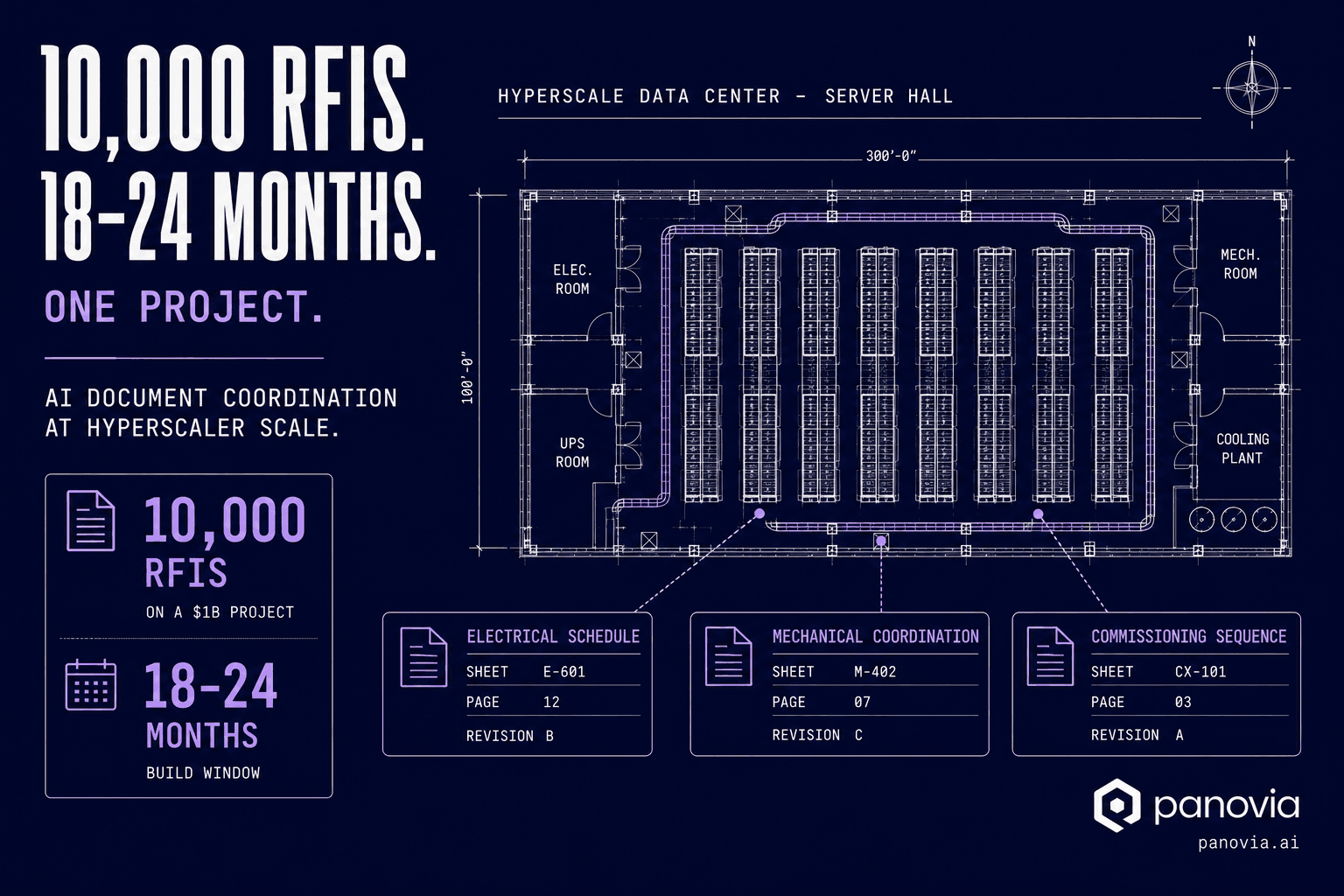
AI document coordination at hyperscaler scale is the use of AI tools to read, cite, and reconcile the dense electrical, mechanical, structural, controls and commissioning documents that flow across a hyperscale data center build from notice to proceed through commissioning. The defining feature is the simultaneous pressure of speed and scale. Hyperscale build time has compressed from approximately 12 months historically to 18 to 24 months on average for current projects. Volume has expanded dramatically: a typical project generates approximately 10 Requests for Information per million dollars of construction value, which on a $1 billion hyperscaler build implies around 10,000 RFIs flowing through the team in under two years.
At this scale, the cost of any single document coordination error compounds. A 60-day delay on a transformer order from a mechanical-electrical specification mismatch is a programme risk, not a research issue. Document intelligence at hyperscaler scale is not “summarising drawings”; it is reconciling source-anchored claims across thousands of documents under tight programme pressure with regulatory, commissioning and client audit ahead.
Why this question is now operative
Three forces are converging through 2026 to make AI document coordination the operative procurement question for AEC firms with hyperscaler exposure.
First, the capex landing on AEC is unprecedented. Amazon, Microsoft, Alphabet, Meta and Oracle disclosed combined 2026 AI infrastructure capex of approximately $660 to 725 billion, a 36% increase from 2025. Approximately $240 billion of that figure flows to physical infrastructure: power, cooling, buildings, land, construction. That is the AEC-addressable market for the hyperscaler build alone, in one year, just from the top five hyperscalers. Goldman Sachs forecasts total hyperscaler capex 2025 through 2027 at $1.15 trillion, more than double the $477 billion spent 2022 through 2024.
Second, the pipeline is structurally large. 190 GW of hyperscale data center capacity has been announced across 777 projects globally, with approximately 148 GW planned, 21 GW in construction and 12 GW already operational. 670 planned colocation and hyperscale projects in 2026 are expected to bring more than 129 GW of capacity online. The US accounts for 15.9 GW of the 23.1 GW currently under construction globally; 92% of US capacity under construction is pre-committed by hyperscalers. Texas is overtaking Virginia as the leading hub. Named megaprojects include Meta's Hyperion campus in Louisiana ($27 billion joint venture with Blue Owl Capital, 2 GW initially scaling to 5 GW), Meta's Prometheus 1 GW Ohio supercluster expected operational this year, Microsoft's 15-building Mount Pleasant Wisconsin campus, AWS's Saudi Arabia region ($5.3 billion) and AWS's European Sovereign Cloud Germany (€7.8 billion through 2040).
Third, the AEC platform vendors have responded. June 2026 alone saw RIB Unify launch as an AI-native cloud platform combining document management, process management and estimating with embedded AI; Bluebeam acquired mbue, a startup using AI to automate review of construction drawings and specifications; Bluebeam launched Bluebeam Revu Max with AI-powered review tools; Maxon launched Redshift for Revit; nima and DOWG announced a UK collaboration to bridge the Project-to-Operations data gap; Graphisoft previewed its Archicad-Forma collaboration layer. The procurement window is not theoretical; it is the conversation AEC procurement panels are running now.
These three forces together make AI document coordination at hyperscaler scale not a research question but a procurement question with an active calendar.
The three architectural commitments that survive the scale
Three commitments separate AI architectures that survive hyperscaler-scale document coordination from those that introduce slip risk at speed.
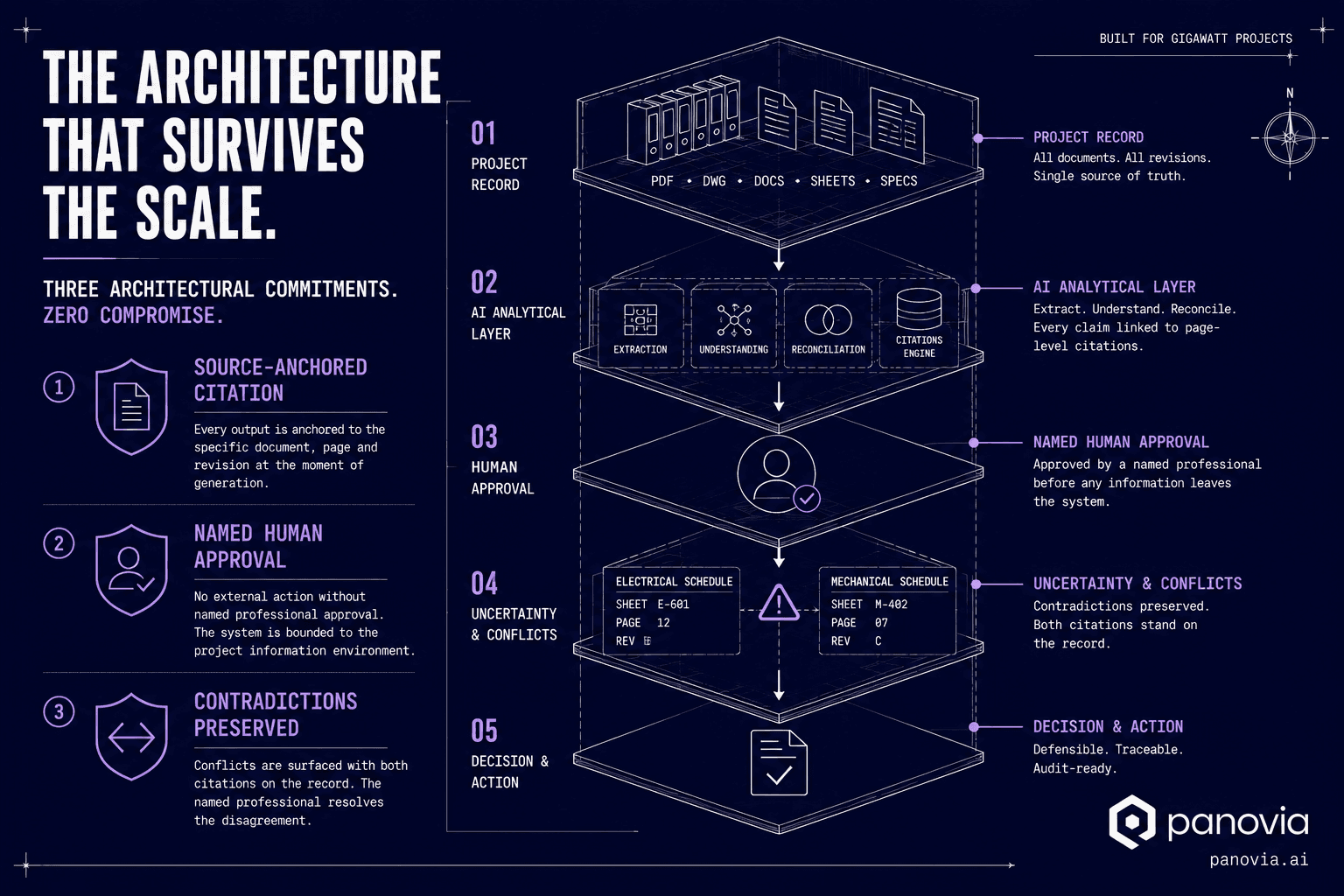
Commitment 1: Source-anchored citation at the moment of generation. Every output the agent produces is anchored to the specific document, page and revision that produced it. The citation exists at the moment the output is generated, not retrofitted from audit logs. At hyperscaler scale, where commissioning and client audit will look back through tens of thousands of documents, retrofitting a citation later is structurally insufficient. The citation has to exist at the moment the team uses the answer to make a procurement, design or coordination decision.
Commitment 2: Named human approval before any external action. The tool does not deliver into the Common Data Environment, the project information environment, the client deliverable or any external system without a named professional from the responsible Appointed Party approving the action. At hyperscaler scale, where the project information environment is processing decisions across thousands of documents weekly, the named-approval gate is what separates AI-as-analytical-aid from AI-as-unaccountable-agent.
Commitment 3: Surfaced uncertainty across sources. Where two source items in the project record disagree (the electrical schedule revision contradicts the mechanical coordination drawing; the updated Equipment Information Requirement contradicts an earlier commissioning script), the tool surfaces the contradiction rather than collapsing it into a synthesised output. At hyperscaler scale, where minor mechanical-electrical scope inconsistencies become commissioning failures, the architecture that refuses to paper over contradictions is the architecture that holds at audit.
All three are architectural commitments, not configurable features. They hold from the first line of code or they do not hold at all.
At hyperscaler scale the configurability question is not just procurement language; it is programme risk.
An AI tool whose citation behaviour can be toggled off in a project setting cannot be evidenced to have cited every output, end-to-end, across the build.
Where document coordination matters most on data center builds
Five operational moments on hyperscaler builds where document coordination compounds the most.
First, MEP coordination across the chilled water plant, switchgear configuration and emergency power systems. Hyperscaler builds compress dense electrical, mechanical, structural, controls and commissioning requirements into a build type where many systems must work under tight tolerances. Contradictions between electrical redundancy configuration (2N versus N+1) and cooling capacity allocation surface in commissioning if not on the record at design.
Second, equipment procurement decision support. Equipment lead times for transformers, switchgear, generators, UPS systems and cooling equipment may be ordered months before installation. An unresolved RFI can freeze procurement or force a field workaround that surfaces in commissioning. Document coordination that reaches an answer with cited authority shortens the procurement cycle without introducing slip risk.
Third, change orders and clarifications under programme pressure. With hyperscale build time at 18 to 24 months and equipment lead times unforgiving, the cost of a change order surfacing late is materially higher than on a 36-month commercial build. Document intelligence that surfaces ambiguity at design rather than papers it over at construction is the procurement signal.
Fourth, commissioning evidence reconstruction. The commissioning team at handover assembles evidence packages traceable to design intent. If the AI tools used by design and construction teams cannot evidence which document produced each cited output, the commissioning team is reconstructing the evidence chain manually under deadline pressure.
Fifth, modular and prefabricated scope coordination. Modular construction is reducing data center project timelines by 30 to 50%, shifting labour need toward logistics and BIM specialists. Modular scope requires document coordination between the offsite manufacturer and the field assembly team that holds across two physical contexts. AI tools that cite at source and surface contradictions are the architectures that hold at the modular interface.
What we are building, and how to test it on your own files
Panovia is purpose-built for AEC document intelligence with the three architectural commitments holding from the first line of code. The Beta is live and free to start at panovia.ai. The pilot launches in a few weeks with deeper processing and broader scope. The architectural commitments are identical across Beta, pilot and beyond.
What the Beta does today: PDF and DWG, page-level citations on the opening pages of each document, one project per user, daily renewable query allowance. Project documents stay private to your workspace. We do not train on customer data.
What it does not do yet: deeper document processing, multi-project workflows, native integrations with the platforms your firm currently uses. All on the roadmap.
Test the architecture on your own hyperscaler project files. Upload your PDF and DWG project files into a one-project workspace. Run the three commitments against real hyperscaler-scale documents.
Common questions
Does Panovia integrate with the platforms my hyperscaler client uses?
Not yet natively. Native integrations are on the roadmap. The Beta and pilot today operate against the firm's PDF and DWG project files directly. The architectural commitments hold regardless of where the source files originated; document intelligence at the file level is the foundation, integrations are the routes that connect the foundation to existing workflows.
How does the architecture handle the volume of documents on a hyperscaler build?
The Beta processes the opening pages of each file by default, optimised for the query allowance. The pilot processes deeper. The architectural commitments do not change with depth; what the architecture can see expands. At hyperscaler scale, processing every page of every document is a different question from being able to evidence citation, approval and surfaced uncertainty across whatever the architecture has processed.
Does the architecture survive at 10,000 RFI scale?
The commitments are architectural rather than load-dependent. An architecture that cites at source on one query cites at source on 10,000 queries. An architecture that requires named human approval before external action does so identically at one document and at one thousand. An architecture that surfaces contradictions does so wherever real contradictions exist in the source documents. Volume changes the scale at which the commitments hold; it does not change whether they hold.
How is this different from RIB Unify, Bluebeam mbue and Bluebeam Revu Max?
RIB Unify and Bluebeam are major AEC platform vendors that have shipped AI features within their established product suites in June 2026. The procurement question is whether the AI behaviour is architectural or configurable, whether it cites at source at the moment of generation or retrofits citations from logs, whether it requires named human approval before external action by structural commitment, and whether it surfaces contradictions or collapses them. AEC firms procuring AI for data center work can ask each vendor those three questions directly.
When will the pilot launch and what changes?
The pilot launches in a few weeks. Deeper processing per file, multi-project workflows, tiered pricing for teams. The architectural commitments are identical across Beta, pilot and beyond. Current Beta users will receive transition communications with at least ten days' notice ahead of any change.
Test the architecture on your own hyperscaler files
The Beta is at panovia.ai. Upload your hyperscaler-scale PDF and DWG project files. Run the three architectural commitments on a real project record. Daily renewable credits. Top up when you need to. The pilot launches in the coming weeks with deeper processing and broader scope.
Request Early AccessTo follow the argument
- Full architectural framework: panovia.ai/blog/h2a2h-governance
- Audit-defensible AI definitional reference: panovia.ai/blog/audit-defensible-ai
- Gateway 2 evidence reconstruction reference: panovia.ai/blog/gateway-2-evidence-reconstruction
- ISO 19650 and AI agent compliance reference: panovia.ai/blog/iso-19650-ai-compliance
- AEC platform consolidation reference: panovia.ai/blog/aec-platform-consolidation
- AI hallucination in AEC work product reference: panovia.ai/blog/ai-hallucination-aec-work-product
- Subscribe to The Reliable Knowledge Layer at thereliableknowledgelayer.substack.com
Sources
- Hyperscaler 2026 AI infrastructure capex. Amazon, Microsoft, Alphabet, Meta and Oracle disclosed combined 2026 capex guidance of approximately $660 to 725 billion, a 36% increase from 2025; approximately $240 billion flows to physical infrastructure. Accuris, “How AI Data Centers Are Reshaping Electronic Component Supply in 2026” (May 2026); Archdesk, “2026 Global AI Data Center Construction” (April 2026); Intellectia, “AI Infrastructure Investment Boom 2026” (June 2026).
- Goldman Sachs capex forecast. Cited at Technerdo, “The $7 Trillion Data Center Boom: Inside AI's Infrastructure Race” (April 2026). Total hyperscaler capex 2025-2027 at $1.15 trillion versus $477 billion 2022-2024.
- Pipeline capacity. Bessemer Venture Partners, “Roadmap: The AI data center stack” (May 2026): 190 GW hyperscale capacity announced across 777 projects globally; 148 GW planned, 21 GW under construction, 12 GW operational. iRecruit, “Hyperscale Data Center News 2026” (June 2026): 670+ projects, 129 GW pipeline. BloombergNEF cited at Archdesk (March 2026): US accounts for 15.9 GW of 23.1 GW under construction globally; 92% pre-committed by hyperscalers.
- Build time. MarketReportsWorld (6 April 2026) cited in Archdesk, “2026 Global AI Data Center Construction” (April 2026): hyperscale build time 18-24 months, up from approximately 12 months. Bessemer Venture Partners, “Roadmap” (May 2026): grid connection currently takes five to seven years.
- Named megaprojects. Meta Hyperion: $27 billion joint venture with Blue Owl Capital, Louisiana, 2 GW initially scaling to 5 GW, 2,250 acres, 4 million square feet. Meta Prometheus: 1 GW supercluster, Ohio, operational 2026. Microsoft 15-building campus, former Foxconn site, Mount Pleasant, Wisconsin. AWS Saudi Arabia $5.3 billion. AWS European Sovereign Cloud Germany €7.8 billion through 2040. Alphabet $4.75 billion acquisition of Intersect Power. Data Center Knowledge, “AI-First Hyperscalers: 2026's Sprint Meets the Power Bottleneck” (March 2026); Archdesk (April 2026); Industry Today, “Here's Where the AEC Industry is Headed in 2026” (January 2026).
- Leading hubs. iRecruit, “Hyperscale Data Center News 2026” (June 2026): Texas and Arkansas attracting major investments; Texas overtaking Virginia as leading hub through 2026.
- AEC platform vendor moves, June 2026. AEC Magazine: “RIB Unify platform launches for construction” (18 June 2026); “Bluebeam acquires mbue in talent and technology investment” (10 June 2026); “Bluebeam brings AI-powered workflows to Revu” (10 June 2026); “Maxon launches Redshift for Revit” (10 June 2026); “nima and DOWG to bridge Project-to-Operations data gap” (12 June 2026); Graphisoft Archicad-Forma collaboration preview (June 2026).
- RFI volume and rework. Build.inc, “RFI Management in Data Center Construction: How AI Keeps Technical Questions from Slipping” (May 2026). Construction.live, “The State of Construction Workflows 2026” (May 2026): 9.9 RFIs per $1 million of construction value; average response time 9.7 days. Autodesk/FMI 2024 research: 52% of construction rework traces to poor project data and miscommunication, over $31 billion annually.
- AI exposure in AEC. Massenkoff, M. and McCrory, P., “Labor Market Impacts of AI: A New Measure and Early Evidence.” Anthropic, 5 March 2026. AEC ~85% theoretical AI task exposure, ~5% observed AI usage; the largest gap of any major industry studied. AEC-lens at Monograph (April 2026).
- Modular construction. iRecruit, “Hyperscale Data Center News 2026” (June 2026): modular prefabrication reducing data center project timelines by 30 to 50%.