The question is not whether the agent is smart enough
For two years, much of the public conversation about AI in construction has been about whether the agent is smart enough. The harder question, the one that decides projects, is whether the decisions and reasoning already on a project can be retrieved when they are needed.
McKinsey's 2025 State of AI report surveyed 1,993 organisations across 105 countries between June and July 2025. Only one per cent of leaders consider their company ‘mature’ on AI deployment. The rest, including ours, are navigating the gap between what AI tools can do in a demo and what they can do in production. In a regulated, evidence-driven industry like construction, that gap is the architectural problem worth solving.
This is the architectural position we are taking publicly for the year ahead, in the hope that more of the AEC sector takes a similar one.
What reconstructive work actually looks like
A senior architect on a higher-risk residential building project, eight months after structural completion, opens her folder on a Tuesday morning. The Building Safety Regulator wants evidence: which decisions, by whom, citing which source documents, on which revisions. Most of the work happened months ago. Most of the rationale lives across a Procore project, a SharePoint folder, a Bluebeam set, a few hundred emails and a thread of WhatsApp messages that probably should not be there but are.
She is doing forensic work. She is reconstructing decision history that the project already produced.
The numbers are improving. BCIS data (for the 12 weeks until 1st May 2026) shows the Building Safety Regulator made 323 Gateway 2 decisions with a 71% approval rate. Median times for new-build cases have fallen to nine weeks. Very different from 2024's 48-week London approval times.
But complex cases still take 35 weeks. Rejected applications take 23 weeks median. The overall average sits at 25 weeks. Remediation medians have risen to 46 weeks.
Average value of a US construction dispute. 12.5 months average length. Most common cause: failure to understand or comply with contractual obligations.
Arcadis 2025 Global Construction Disputes ReportNot malice, not incompetence. The decision history was not where people needed it, when they needed it.
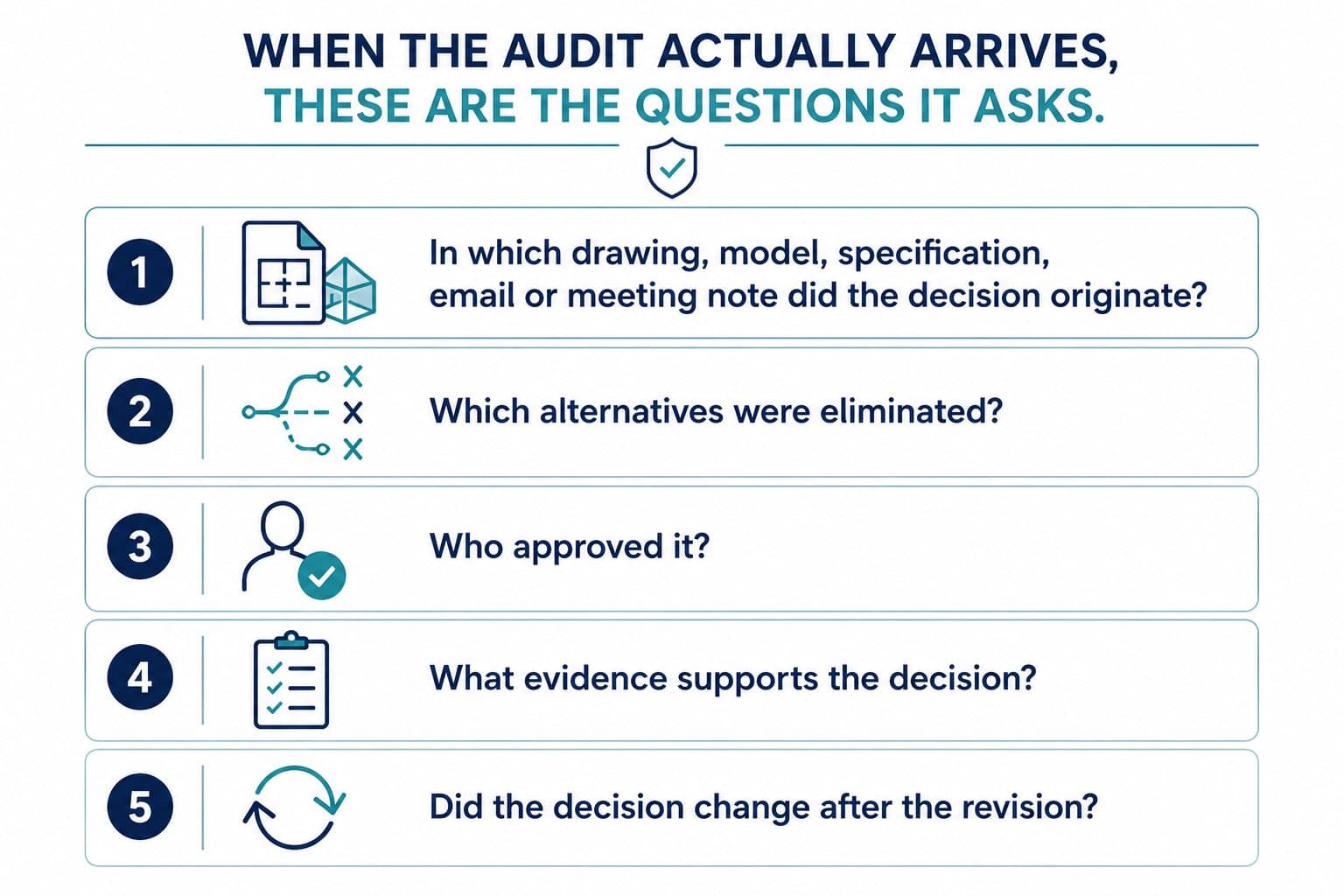
Reconstruction is what happens when the project record cannot answer those questions directly. The architectural problem is not that the questions are hard. The answers live in fragmented places, in formats that were not designed to be queried and the person being asked the questions is the only retrieval mechanism in the room.
This sits alongside a workforce crisis. The 2025 AGC-NCCER Workforce Survey reports 92% of US construction firms struggling to hire qualified workers, and 45% reporting project delays caused by labour shortages.
The systems hold the artefacts. They do not hold the rationale.
The three commitments any honest architecture has to make
Hallucination is not a bug that the next model release will patch.
A 2025 mathematical proof confirmed that hallucinations cannot be fully eliminated under current large language model architectures. OpenAI's 2026 research went further, making explicit that the training incentive structure rewards confabulation over abstention. MIT research found LLMs are 34% more likely to use confident language when they are wrong.
The architecture cannot eliminate fabrication.
The training rewards confidence.
The confidence is highest when the answer is wrong.
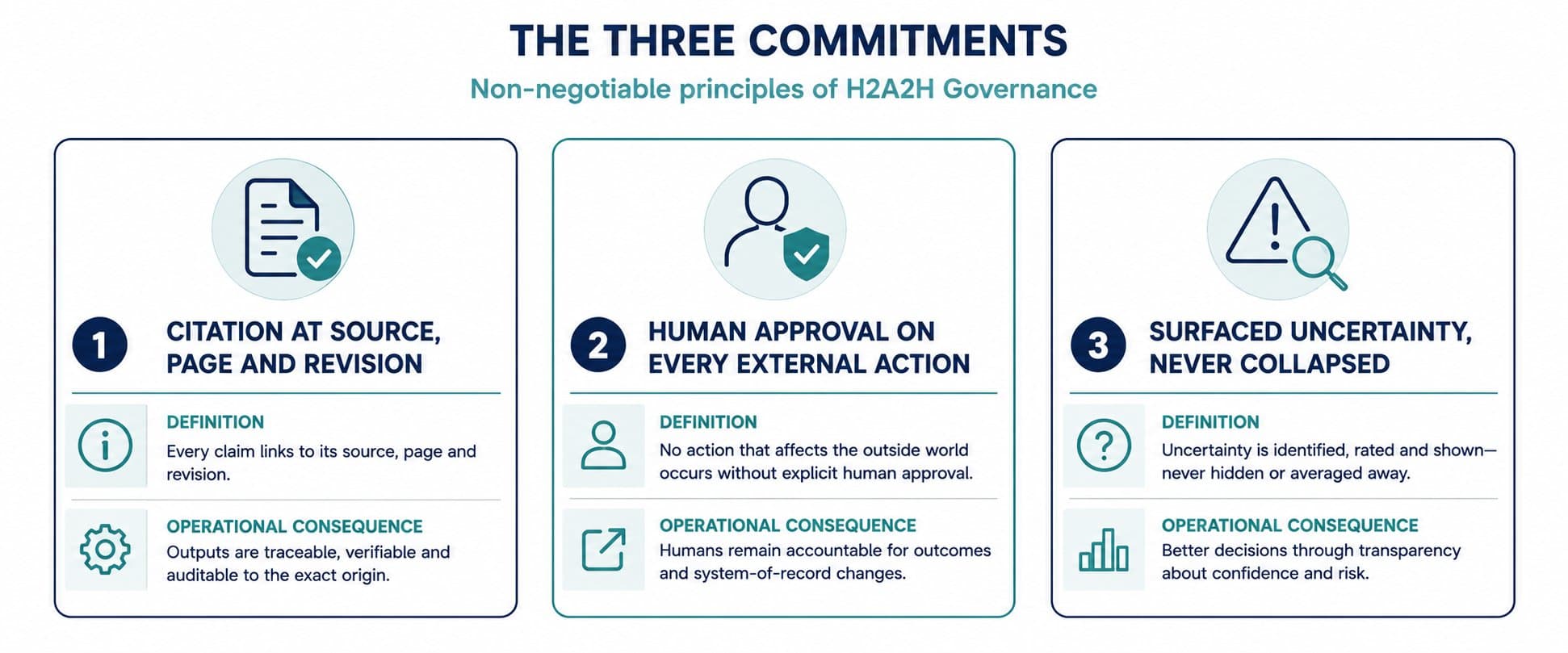
The first is citation at source, page and revision. Every output the agent generates is anchored to the specific document, page or model element, and the specific revision, that produced it. Verifiability is the default state.
The second is human approval on every external action. The agent does not send emails on its own. It does not change records in connected systems on its own. Where the agent's work crosses into the world, a human approves first.
The third is surfaced uncertainty, never collapsed. Where sources disagree, both citations surface. The agent does not pick. The agent does not paper over. Uncertainty is exposed, with its sources, for the human to resolve.
H2A2H Governance, defined
We call this Human-to-Agent-to-Human Governance.
The architecture is a discipline rather than a feature. A human initiates. The agent processes, with citation and uncertainty surface built in. The human approves anything the agent will do in the world. The agent acts. The trail remains queryable.
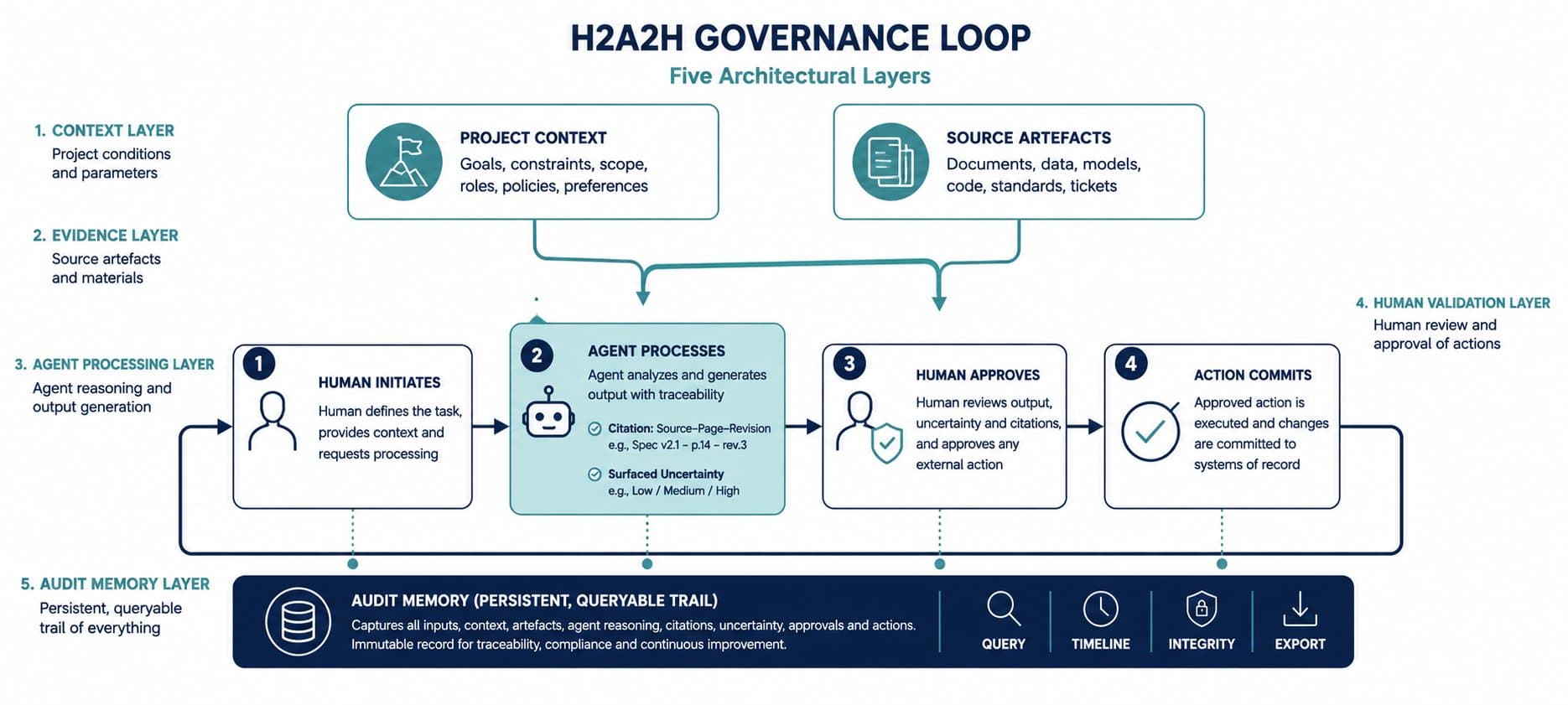
Governance is structural. The three commitments are not switches; they are how the system is built. A Panovia answer that does not carry a citation is not a misconfigured Panovia answer; it is not a Panovia answer at all.
What we are building
Panovia is an AI coordination and knowledge platform for Architecture, Engineering and Construction, built around H2A2H Governance from the first line of code.
The first beta cohort opens to invited firms across the UK, USA, UAE, KSA and Turkey. Cohort firms work with Panovia on the file and document layers under H2A2H discipline: cited answers on drawings, models and specifications; surfaced uncertainty across revisions; human approval on every external action.
The conversation we want to be in
If you have spent time on this problem — the failure mode in AI trust, the reconstruction work, the workforce gap, the regulatory pressure — we would value your perspective.
To test the beta with your team, write to efehan@panovia.ai.
Common questions
What is H2A2H Governance?
Human-to-Agent-to-Human Governance is an architectural commitment for AI in regulated industries. Three commitments define it: every agent output cites source, page and revision; every external action requires human approval; uncertainty is surfaced when sources disagree, never collapsed into a guess.
What does H2A2H Governance actually have to answer in an audit?
The operational questions any rigorous audit asks: In which document did the decision originate? Which alternatives were eliminated? Who approved it? What evidence supports the decision? Did the decision change after the revision?
Why is hallucination an architectural problem?
A 2025 proof confirmed hallucinations cannot be fully eliminated under current LLM architectures. OpenAI’s 2026 research showed training rewards fabrication over abstention. MIT found LLMs are 34% more likely to use confident language when wrong.
How is Panovia different from Procore Assist or Construction IQ?
Procore Assist operates within Procore. Construction IQ operates within Autodesk. Panovia is built as an overlay across the existing AEC stack, with the three H2A2H commitments architectural rather than configurable.
How do I get access to Panovia?
An invitation-only beta cohort is being assembled. To register interest, write to efehan@panovia.ai.
See Panovia in action.
A focused walkthrough for your coordination and documentation challenges.
Request Early AccessSources
- BCIS Building Cost Information Service — BSR data, 12 weeks to 1 May 2026
- Arcadis 15th Annual Global Construction Disputes Report, June 2025
- McKinsey State of AI 2025, November 2025
- AGC of America 2025 Workforce Survey, August 2025
- Published hallucination research 2025–2026 (OpenAI, MIT)