What this page is
This page is for Senior Experts, Economic Buyers, compliance and risk professionals at AEC firms forming a procurement view on AEC AI tools after the platform consolidation events of late May and early June 2026. It documents two specific verified events, names the architectural question both events raise for AEC firms, and explains the three architectural tests an AEC AI tool has to pass to remain defensible inside firms procuring under PI insurance scrutiny, BSR audit and client procurement. All claims are anchored to numbered footnotes at the bottom of this page.
Two events, ten days apart
Event 1: Autodesk announced the acquisition of MaintainX on 28 May 2026, an all-cash transaction valued at approximately $3.6 billion.1 It is the largest acquisition in Autodesk's history.2 The deal creates a new Autodesk Operations Solutions (AOS) division bringing MaintainX together with Fusion Operations, Tandem digital twin, and Flexsim simulation under a single unified platform. MaintainX targets more than $135 million in annualised recurring revenue for calendar year 2026 with growth above 50%. AEC Magazine's analysis observed that the price represents more than 20x forward revenue and signals that Autodesk's growth path beyond design seats now runs through operations and AI.3
Andrew Anagnost, Autodesk CEO, said in the Q1 FY27 release on the same day:
Our customers need AI that produces outputs that are accurate in the real world. That requires data, context, and expertise. Each one is scarce and what differentiates Autodesk is that we have all three at scale.2
Event 2: Procore launched its connected Common Data Environment with agentic AI coworkers on 7 June 2026.45 The platform was built on Datagrid, the vertical AI firm Procore acquired in January 2026 for an undisclosed sum. Datagrid founder Thiago da Costa joined Procore to lead AI and data strategy. The CDE positions itself as a “single, verified source of truth tying together BIM models, documents, quality records and asset information” from design sign-off to handover, with agentic AI coworkers automating workflows including submittal reviews and RFI drafting.
What the race is actually about
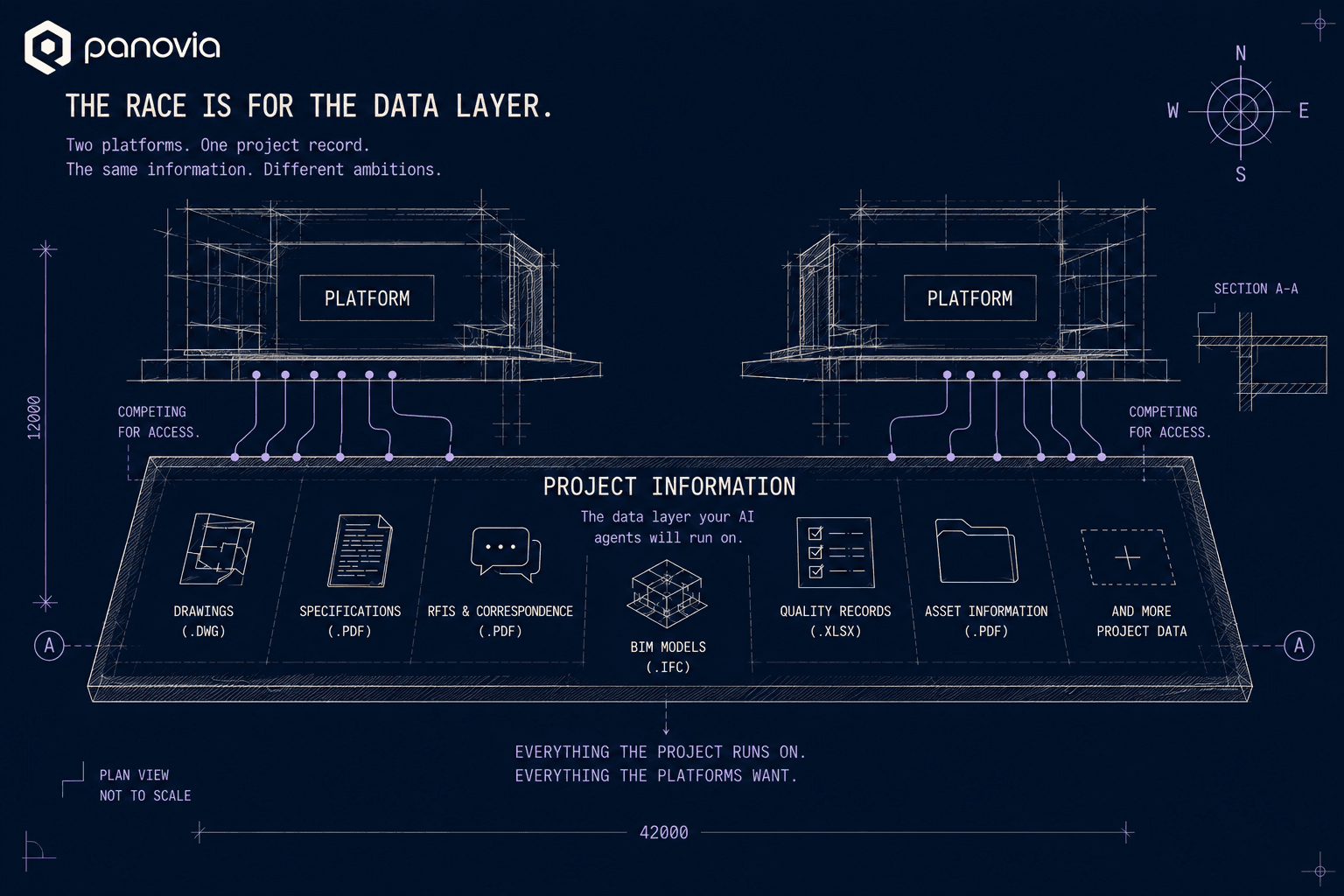
Engineering News-Record published a piece within the last week summarising the moment with characteristic directness: the platforms are fighting over the data layer your AI agents will run on.6
The race is not about giving AEC firms better AI. It is about owning the operating layer on top of project data those firms already pay platforms to hold.
That changes the procurement question for an AEC firm.
The question is no longer which platform to trust your AI to. The question becomes which architecture refuses to take the choice away from you. Where does your project data sit? Who can train on it? Where do your AI tool's answers come from? Who decides whether those answers go onto the record?
These questions cannot be answered through feature comparisons because the answers are architectural, not configurable. A platform can ship a citation feature. An architecture either generates citations at the moment of output or it does not. A platform can offer human approval gates. An architecture either requires them on every external action or it does not. The structural property either holds from the first line of code or it does not hold at all.
The three architectural tests an AEC AI tool has to pass in the new market
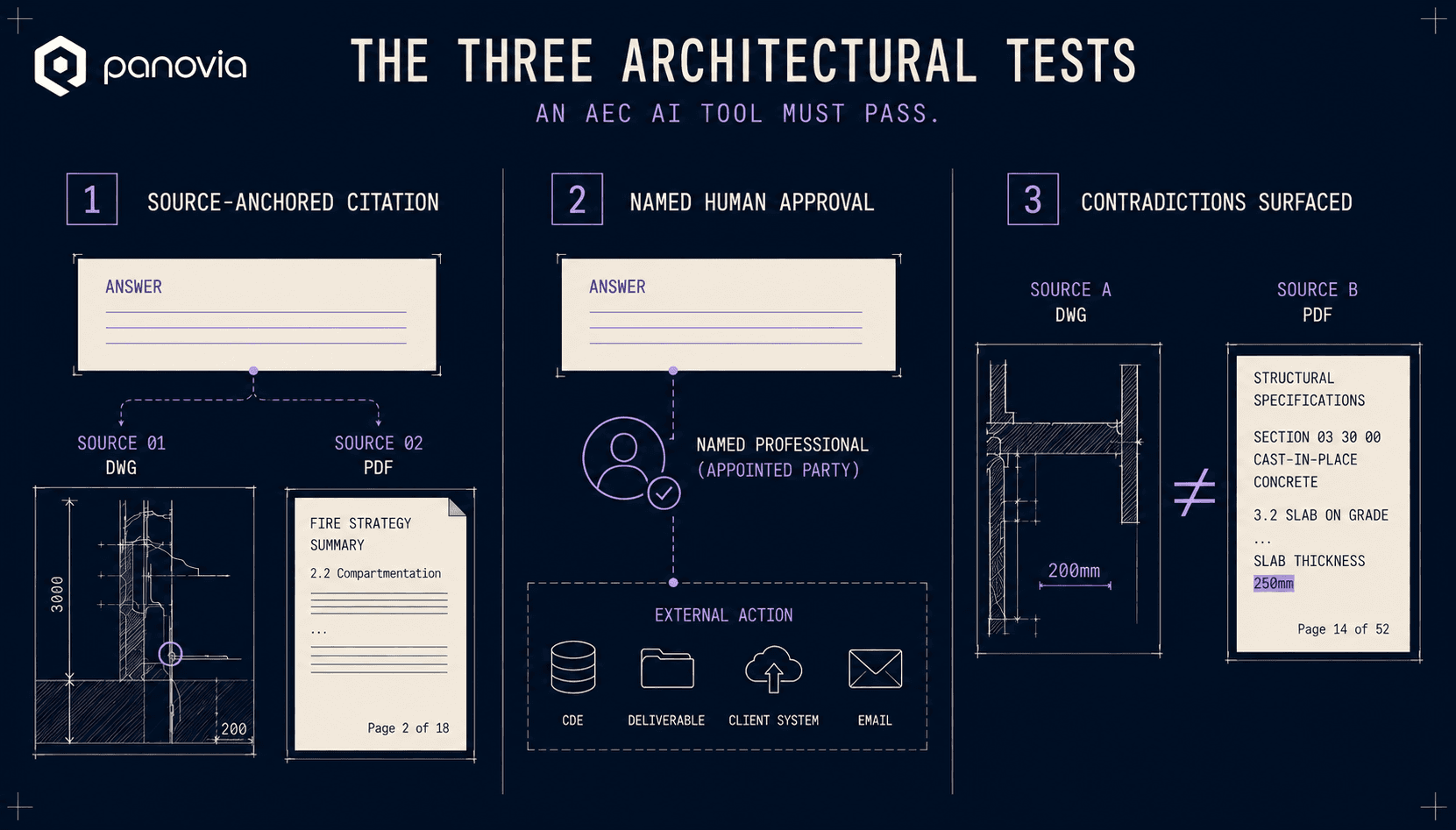
Test 1: Source-anchored citation at the moment of generation. Every output the tool produces traces back to the specific document and the specific page that produced it. The citation exists at the moment the output is generated, not retrofitted from audit logs after the fact. When a PI insurer, BSR inspector or client procurement reviewer asks where an output originated, the answer is structurally available, not reconstructed from logs.
Test 2: Named human approval before any external action. The tool does not deliver into the project information environment, the Common Data Environment, the client deliverable or any external system without a named professional from the responsible Appointed Party approving the action. The tool's autonomy is bounded to the analytical layer. The consequential delivery action is human-approved and named.
Test 3: Contradictions between sources surfaced rather than collapsed. Where two source items in the project record disagree, the tool surfaces both citations and lets the named professional resolve the disagreement on the record. Architectures that average, guess, or silently pick a side do not pass this test because audits eventually find the contradiction the tool collapsed.
All three are commitments that have to hold from the first line of code or they do not hold at all.
Configurable tests are not tests.
Where Panovia sits in relation to the race
Panovia is purpose-built for AEC document intelligence with the three architectural tests holding from the first line of code. We are not the operating platform layer Autodesk and Procore are racing for. We are the conversational AI agent for AEC documents whose architecture refuses to collapse the verification questions the firm needs answered on the record.
What that means in practice today, in the Beta:
What the Beta does today: PDF and DWG, page-level citations on the opening pages of each document, one project per user, daily renewable query allowance. Project documents stay private to your workspace. We do not train on customer data.
What it does not do yet: deeper document processing, multi-project workflows, native integrations with the platforms your firm currently uses. All on the roadmap.
The MVP launches in a few weeks with deeper processing and broader scope. The three architectural tests remain identical across Beta, MVP and beyond.
What this means for procurement in the next two quarters
Three implications for AEC firms procuring AI tools through the end of 2026.
First, procurement criteria for AEC AI tools should now name the three architectural tests structurally rather than asking about features. The right RFI question is not “does your tool cite sources?” but “is source citation an architectural commitment that holds from the first line of code, or is it a configurable feature?”
Second, data sovereignty becomes a procurement criterion, not a procurement preference. AEC firms whose project data is being used to train platform AI agents face questions from PI insurers, BSR inspectors and clients about where that data went and what was done with it. Tools whose architecture keeps customer data private by structural commitment are different in kind from tools whose default settings are configurable.
Third, the boundary of perception matters more than capability claims. AEC firms need AI tools that name what they can and cannot see, the moment they cannot see it. The survey research we ran on the Beta launch was specific on this: 88% of respondents named radical transparency about scope and limitations as the highest single trust signal an AEC AI vendor can offer.
of respondents named radical transparency about scope and limitations as the highest single trust signal an AEC AI vendor can offer.
Panovia Beta launch survey researchVerifiable industry data
Three industry data points anchor the procurement conversation we are having with AEC professionals this month.
Anthropic published research on 5 March 2026 finding that architecture and engineering has roughly 85% theoretical AI task exposure but only approximately 5% observed AI usage, the largest gap of any major industry studied.78 The implication is that AEC is the single largest unused AI opportunity in the global economy, and the tools that win in AEC will be the tools whose architecture matches AEC's actual procurement constraints, not the tools whose features look impressive in horizontal AI demos.
BST Global, in partnership with the ACEC Technology Committee, published its second annual “AI + Data Insights 2026: Global AEC Industry Report” on 4 May 2026.9 The report documents that AEC firms are shifting from AI experimentation toward intentional strategy and organisational readiness for AI on real project work.
The UK Building Safety Regulator's latest Gateway 2 data shows a 75% approval rate in the 12 weeks to 30 May 2026, up from 71% in the previous period, with the Innovation Unit at 90%.10 The regulatory environment is sharpening, not softening, in parallel with the platform consolidation race.
Test the architecture on your own files
The Beta is at panovia.ai. Upload your PDF and DWG project files. Run the three architectural tests on a real project record. Daily renewable credits. Top up when you need to. The MVP launches in the coming weeks with deeper processing and broader scope.
Request Early AccessTo follow the argument
- Full architectural framework: panovia.ai/blog/h2a2h-governance
- Gateway 2 evidence reconstruction reference: panovia.ai/blog/gateway-2-evidence-reconstruction
- Audit-defensible AI definitional reference: panovia.ai/blog/audit-defensible-ai
- ISO 19650 and AI agent compliance reference: panovia.ai/blog/iso-19650-ai-compliance
- Subscribe to The Reliable Knowledge Layer at thereliableknowledgelayer.substack.com
Footnotes
- 1. Autodesk, Inc. “Autodesk to acquire MaintainX, advancing unified platform in operations.” Autodesk News, 28 May 2026. adsknews.autodesk.com/en/news/autodesk-to-acquire-maintainx-advancing-unified-platform-in-operations/
- 2. Autodesk, Inc. Form 8-K, Q1 FY27 Press Release. Securities and Exchange Commission, 28 May 2026. Andrew Anagnost quote in context of Q1 FY27 results and MaintainX announcement.
- 3. AEC Magazine. “Autodesk buys MaintainX for $3.6bn.” AEC Magazine, June 2026. aecmag.com/operations/autodesk-buys-maintainx-for-3-6bn/. AEC Magazine's deal analysis observes the >20x forward revenue multiple and the implication for Autodesk's growth path.
- 4. AEC Magazine. “Procore CDE lays foundation for agentic AI.” AEC Magazine, 7 June 2026. aecmag.com/collaboration/procore-cde-lays-foundation-for-agentic-ai/. Datagrid acquisition January 2026 powers agentic AI coworkers automating workflows.
- 5. Highways.today. “Procore Turns the Common Data Environment into a Launchpad for Agentic AI.” 8 June 2026. highways.today/2026/06/07/procore-cde-agentic-ai/. Single verified source of truth framing and Thiago da Costa role at Procore.
- 6. Engineering News-Record. “Construction Platforms Are Already Fighting Over Data to Train AI Agents.” Engineering News-Record, June 2026. enr.com/articles/63122-construction-platforms-are-already-fighting-over-data-to-train-ai-agents
- 7. Massenkoff, M. and McCrory, P. “Labor Market Impacts of AI: A New Measure and Early Evidence.” Anthropic, 5 March 2026. anthropic.com/research/labor-market-impacts. Theoretical exposure derived from Eloundou methodology; observed usage from Anthropic Economic Index; occupational task definitions from O*NET.
- 8. Monograph. “Why Architecture and Engineering Have the Most Untapped AI Potential of Any Industry.” Monograph, April 2026. monograph.com/blog/ai-impact-architecture-engineering-firms. AEC-specific interpretation of the Anthropic research data.
- 9. BST Global. “AI + Data Insights 2026: Global AEC Industry Report.” Business Wire, 4 May 2026. businesswire.com/news/home/20260504912104/en/. Produced in partnership with the BST Global AI + Data Consortium and the American Council of Engineering Companies (ACEC) Technology Committee. Foreword by ACEC Technology Committee Chair Dave Mulholland.
- 10. BCIS. “Latest Building Control Approval Application Data.” Building Cost Information Service, June 2026. bcis.co.uk/news/latest-building-control-approval-application-data/. 358 Gateway 2 decisions in the 12 weeks to 30 May 2026; 75% approval rate (up from 71%); Innovation Unit at 90% approval.