What this page is
This page is for Senior Architects, Technical Directors, Directors of Digital Delivery and Information Managers working on higher-risk buildings under the UK Building Safety Act 2022. It defines Gateway 2 evidence reconstruction in operational terms, names the five recurring questions the Building Safety Regulator asks of a Gateway 2 submission, and explains why this reconstruction work is the architectural problem AEC AI is now being asked to solve.
The page sits alongside our full architectural argument at panovia.ai/blog/h2a2h-governance.
What Gateway 2 evidence reconstruction means
Gateway 2 is the stage of the Building Safety Act 2022 process that approves a higher-risk building's design before construction can begin. The Building Safety Regulator, part of the Health and Safety Executive, reviews the design submission to confirm fire and structural safety have been demonstrated. The review applies to higher-risk buildings of at least seven storeys or eighteen metres in height, containing at least two residential units.
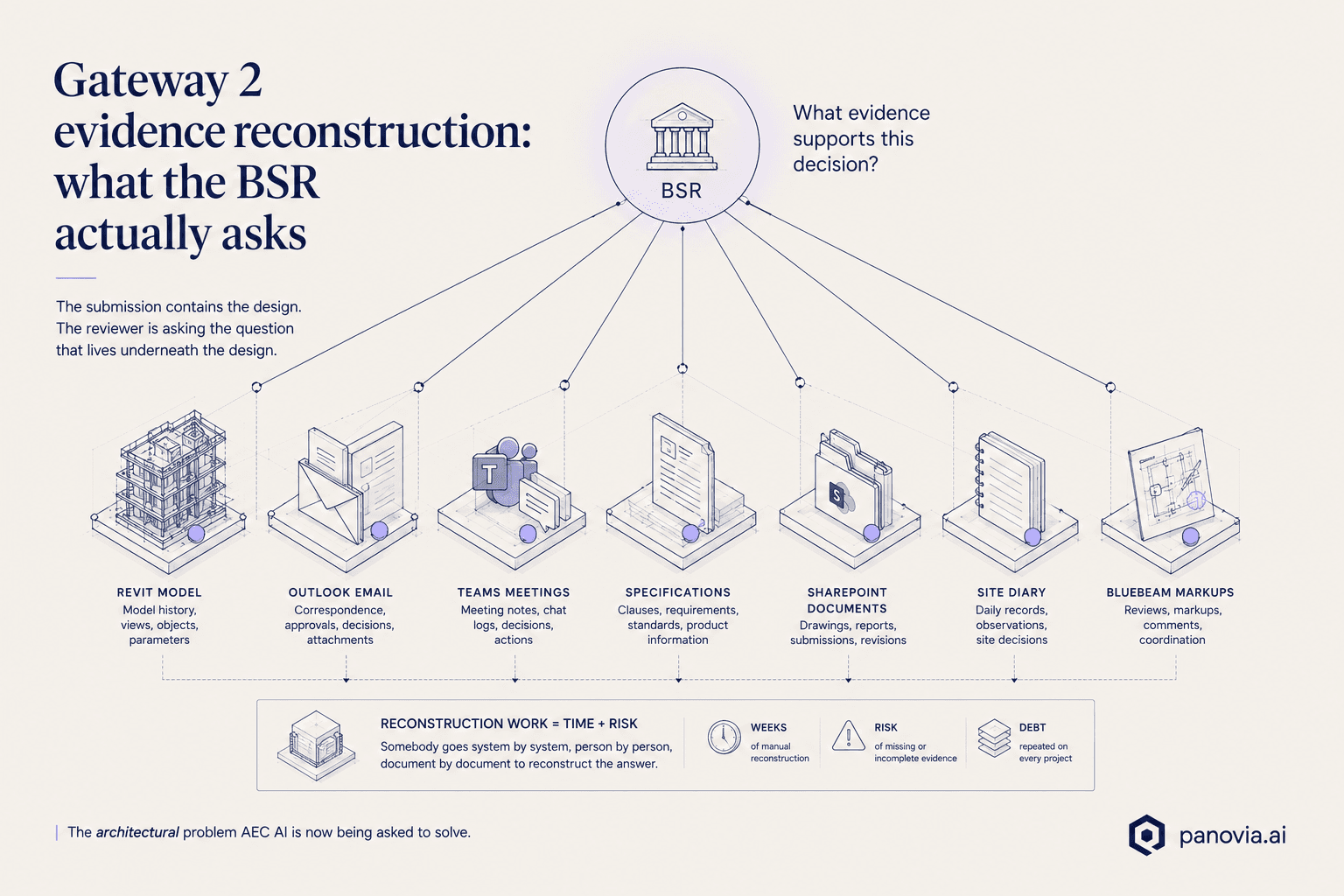
The reconstruction part of the phrase refers to the work that happens when the BSR reviewer asks: what evidence supports this decision. The submission contains the design. The reviewer is asking the question that lives underneath the design.
In a well-run project, the answer is immediately retrievable from the project record. In most projects, the answer has to be reconstructed from emails, meeting notes, model history, specification revisions and informal communication channels. That reconstruction is what we are talking about when we say reconstruction debt.
Where the BSR is in 2026
The numbers underneath the reconstruction work are improving. BCIS data for the twelve weeks to 1 May 2026 shows the Building Safety Regulator made 323 Gateway 2 decisions in the reporting period, with an overall approval rate of 71%. London continues to represent 62% of all Gateway 2 activity. New-build cases moving smoothly through the batching process reach decisions in a median of nine weeks. The average across all approvals is twenty-five weeks, reflecting older 2024 and 2025 cases still being concluded.
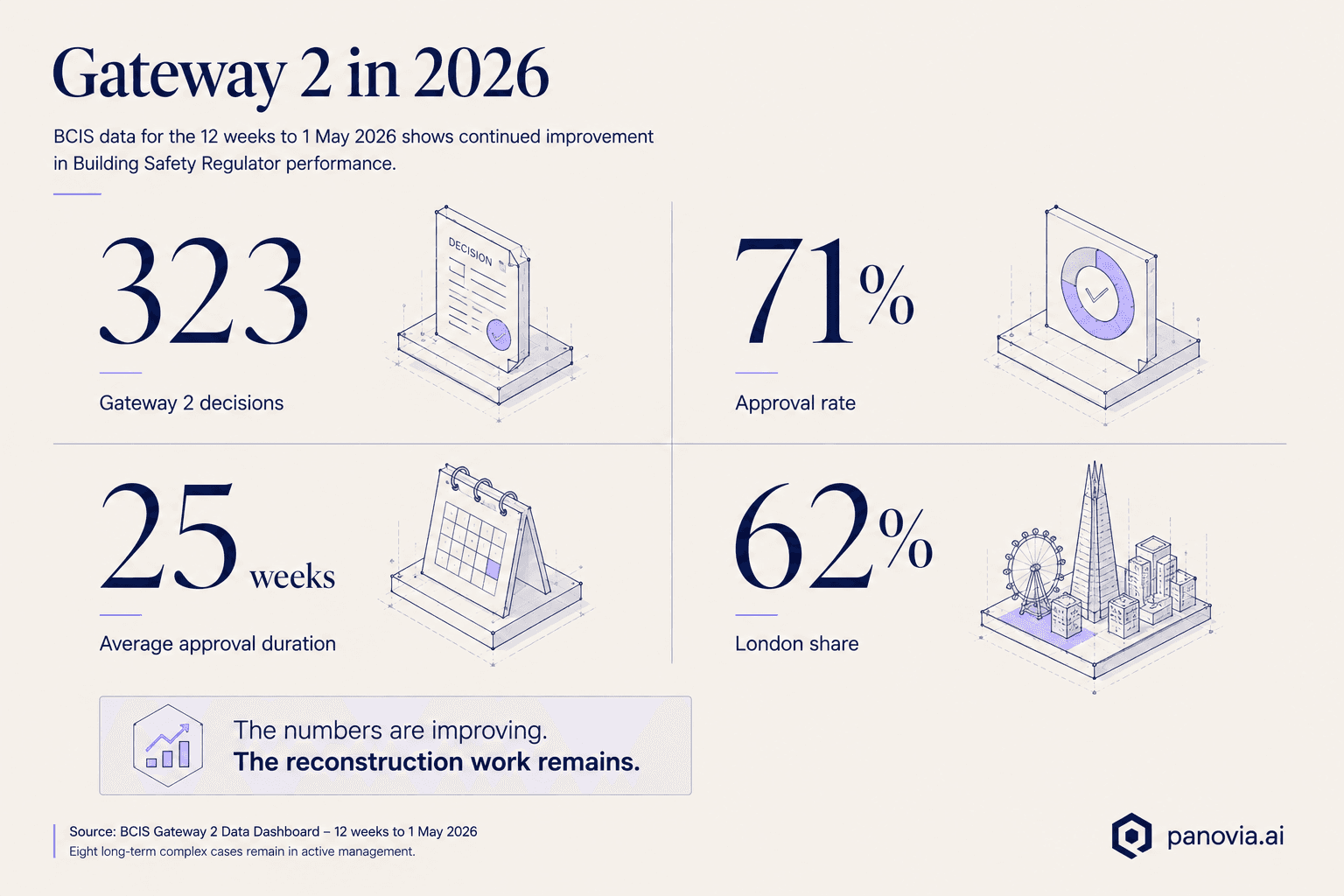
Eight long-term complex cases remain in active management, down from a much larger legacy caseload twelve months ago. Charlie Pugsley, the Acting Chief Executive Officer of the Building Safety Regulator, told Construction Management magazine in May 2026 that operational improvements and intensive applicant engagement have driven the approval rate increases, while remaining committed that “accelerated decision-making must never come at the cost of building safety”. The picture is genuinely different from the 48-week London approval times of 2024.
What the numbers do not yet show is how the 29% of applications that are not approved divide between architecturally unsound submissions and architecturally sound submissions that could not produce the evidence to defend themselves. The reconstruction problem is most acute in the second category.
The five questions the BSR actually asks
The Building Safety Regulator's review process asks the same forensic questions across every Gateway 2 submission. Five questions sit underneath every decision a reviewer scrutinises.
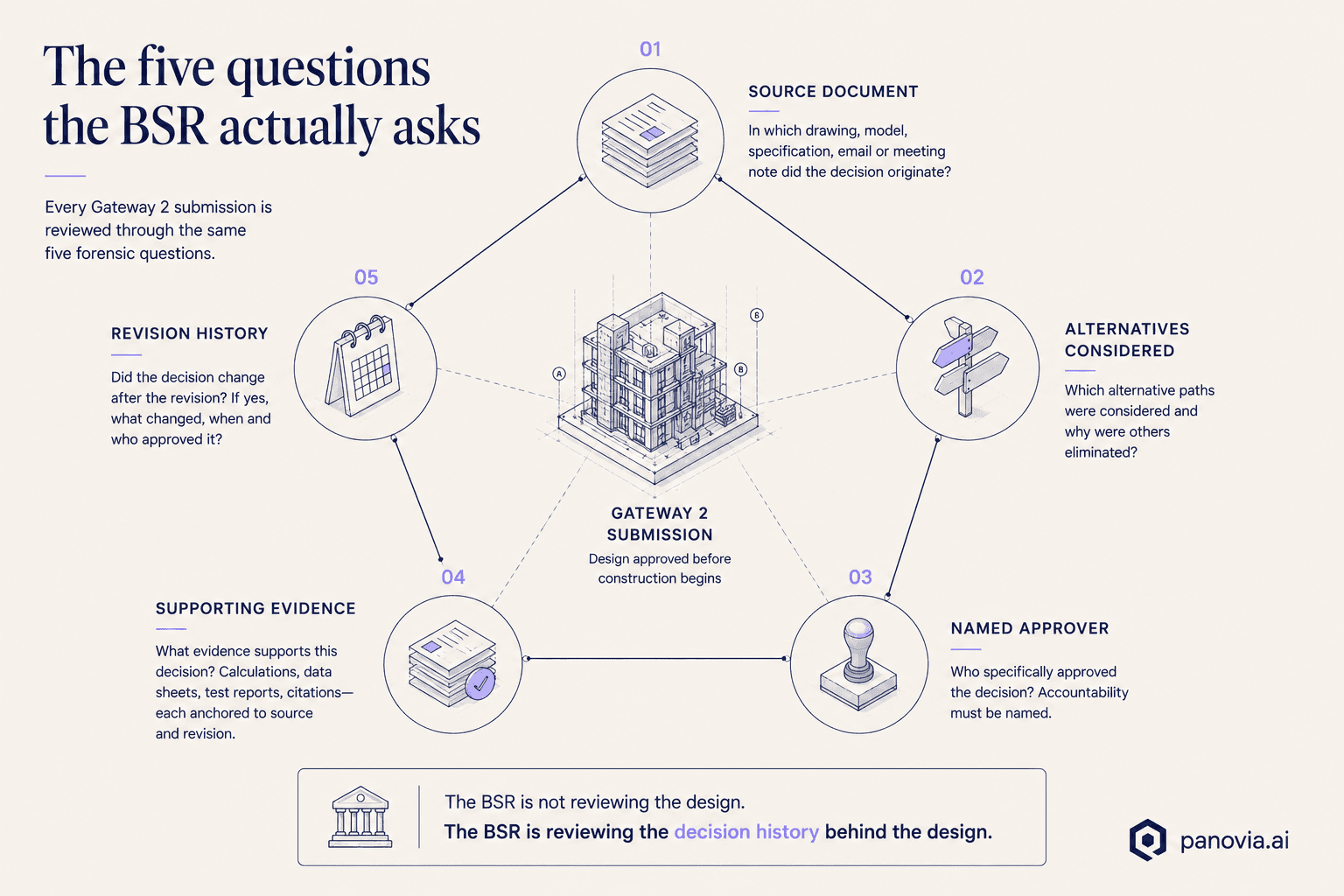
In which drawing, model, specification, email or meeting note did the decision originate?
The reviewer needs to trace a design decision back to its source. If the answer is “we discussed it in a Teams call in October”, that is not retrievable. The design submission has to anchor the decision to a specific document and a specific revision.
Which alternatives were eliminated?
The reviewer often wants to understand why a particular design choice was made rather than another. The alternatives considered and rejected are themselves evidence.
Who approved it?
Accountability is named. The reviewer expects to see the specific named professional who approved each decision, not “the team agreed”.
What evidence supports the decision?
Calculations, manufacturers' data sheets, test reports, third-party certifications, regulatory citations. Each one anchored to source and revision.
Did the decision change after the revision?
Designs evolve through revisions. The reviewer asks whether a decision originally approved on a Rev 03 drawing was later changed in Rev 06, and whether the change itself was approved and evidenced.
These five questions are not edge cases. They are the standard structure of a Gateway 2 review.
Why this is an architectural problem
The current pattern in most AEC firms is that the answers to these five questions live across multiple systems and several people's memories.
A typical project on a higher-risk building uses Procore for project management, SharePoint for document control, Bluebeam for drawing markups, Revit for model coordination, Outlook for email correspondence, Microsoft Teams for meetings, occasional WhatsApp threads for fast-moving decisions, and a hard-copy site diary for daily reports. Each of these holds part of the answer to the BSR's five questions. None of them holds all of it.
When the BSR review arrives, somebody on the project (usually a Senior Architect or Technical Director with eight to twelve years of memory on the project) reconstructs the decision history by going system by system, person by person, document by document. The reconstruction takes weeks. The 25-week average sitting inside the BCIS 2026 numbers absorbs that work.
The architectural answer is not to have a better Procore plugin or a more comprehensive SharePoint folder structure. The architectural answer is to make the project record itself queryable in the way the BSR asks questions of it.
What an architectural answer looks like
Three commitments hold any agent that is going to be trusted with reconstruction work.
Citation at source, page and revision. Every answer the agent gives is anchored to the specific document, the specific page, and the specific revision that produced it. The reviewer who interrogates the answer has the source one click away.
Human approval on every external action. The agent does not file a Gateway 2 submission on its own. It does not send a letter to the BSR on its own. It does not commit the firm to a counterparty on its own. Where the agent's work crosses into the world, a human approves first. The agent's autonomy is bounded to the analytical and informational layer; the consequential layer is human.
Surfaced uncertainty, never collapsed. Where the original specification says one thing and the revised drawing says another, both citations surface. Where two sources disagree, the agent does not pick. The agent exposes the disagreement, with its sources, and the human resolves it.
These three commitments together form the architectural posture we call Human-to-Agent-to-Human Governance. The full architectural argument sits at panovia.ai/blog/h2a2h-governance.
What we are building
What we are building at Panovia is the architecture this moment in AEC calls for. The agent we are putting into AEC firms' hands cites at source, page and revision. It waits on a human before any external action. It surfaces uncertainty rather than collapsing it. The early use cases focus on the operational moments named throughout this page: the Gateway 2 evidence reconstruction, the payment-app defence, the multilingual safety record, the cross-stack reasoning question under cost and tender pressure.
The first beta cohort is currently being assembled across the UK, USA, UAE, KSA and Turkey. Cohort firms work with Panovia on the file and document layers under H2A2H discipline.
Common questions
What is the Building Safety Regulator?
The Building Safety Regulator is part of the UK's Health and Safety Executive. Established under the Building Safety Act 2022, it oversees the design, construction and occupation of higher-risk buildings of at least seven storeys or eighteen metres in height with at least two residential units. The BSR conducts the Gateway 2 (design) and Gateway 3 (completion) reviews. Charlie Pugsley is the Acting Chief Executive Officer in 2026.
What is Gateway 2?
Gateway 2 is the design-stage review the Building Safety Regulator conducts before construction can begin on a higher-risk building. The applicant submits a Building Safety Case showing how the design demonstrates fire and structural safety. The Building Safety Regulator reviews the submission, asks questions, and either approves or rejects it.
How long does Gateway 2 take in 2026?
BCIS data for the twelve weeks to 1 May 2026 shows median times of nine weeks for new-build cases moving smoothly through batching, and an overall average of twenty-five weeks across all approvals. The picture is materially improving from the 48-week London approval times of 2024. The eight long-term complex cases under active management at the Building Safety Regulator are exceptions to the trend.
What evidence does the BSR ask for at Gateway 2?
Five recurring questions: source of each decision (in which drawing, model, specification, email or meeting note); alternatives considered; the named approver; supporting evidence (calculations, data sheets, test reports); and whether the decision changed after revision.
Is AI allowed in Gateway 2 submissions?
The Building Safety Act 2022 does not prohibit AI assistance in preparing a Gateway 2 submission. What the regulatory framework requires is that every decision in the submission be evidenced and approved by a named professional. AI that supports the human professional in retrieving evidence, drafting submission text, or identifying inconsistencies is compatible with the regulatory framework. AI that generates submission content without source citation and human approval is not.
How does Panovia help with Gateway 2 evidence reconstruction?
Panovia is being built to make project records queryable in the way the Building Safety Regulator asks questions of them. Citation at source, page and revision means the answer to “in which drawing did this decision originate” is one click away. Human approval on external action means the agent does not file a submission on its own. Surfaced uncertainty means contradictions between specifications, drawings, emails and meeting notes are exposed for human resolution rather than collapsed into a guess.
What is the difference between Gateway 2 and Gateway 3?
Gateway 2 is the design-stage review before construction can begin. Gateway 3 is the completion-stage review before a higher-risk building can be occupied. As the earliest Gateway 2 approved projects approach completion, industry attention is starting to turn to Gateway 3 evidence requirements, where less government guidance has been issued than at Gateway 2.
To test the beta
Write to efehan@panovia.ai. The first beta cohort is currently being assembled across the UK, USA, UAE, KSA and Turkey.
Request Early AccessTo follow the architectural argument
- The full argument sits at panovia.ai/blog/h2a2h-governance.
- Subscribe to The Reliable Knowledge Layer at thereliableknowledgelayer.substack.com for the weekly Friday issue.
- BCIS Building Cost Information Service — BSR data, 12 weeks to 1 May 2026.
- Construction Management magazine interview with Charlie Pugsley, May 2026.