What this page is
This page is for Information Managers, Common Data Environment administrators, and Senior Experts working under ISO 19650 internationally. It defines what the standard requires of AI agents operating inside the project information delivery chain, names the three points at which ISO 19650 audits ask hard questions of AI-assisted work product, and walks one specific worked example through the framework. Every claim is anchored to a verifiable source inline.
What ISO 19650 requires, briefly
ISO 19650 is the international standard for information management using building information modelling. The standard defines a three-party structure. The Appointing Party (typically the client). The Lead Appointed Party (typically the lead consultant or main contractor). The Appointed Party (typically subcontractors and specialist consultants). Each party has named responsibilities tracked through the project lifecycle.
Information is exchanged through a Common Data Environment, governed by an Information Delivery Plan, and aligned to Organisational, Asset, Project and Exchange Information Requirements. Three threads run through the standard. Accountability. Auditability. Quality.
Where AI agents intersect ISO 19650 obligations
AI agents now operate inside the information delivery chain at three points where the audit asks hard questions.
Point 1: Information generation. AI agents drafting information that will be delivered under an ISO 19650 exchange are subject to the same accountability standards as human-generated information. The Appointed Party delivering AI-assisted information is responsible for it.
Point 2: Information review and validation. AI agents reviewing information for completeness, consistency or Information Delivery Plan compliance are operating inside the assurance step of the standard. The Lead Appointed Party signing off on AI-assisted review work is responsible for it.
Point 3: Information handover at completion. AI agents assembling Asset Information Models or preparing handover information are at the most audited step. The information delivered must demonstrate that it meets the originally specified requirements with a clear audit trail back to the source.
At each point, the audit asks two structural questions. Where did this information originate? Who approved its inclusion in the delivery?
The architecture an AI tool needs to be safe inside the chain
AEC Magazine's April 2026 cover commentary “Agentic BIM's missing infrastructure” referenced Google DeepMind's “Intelligent AI Delegation” research and concluded that the supporting architecture for agentic operation in BIM environments is “missing entirely” (AEC Magazine, 28 April 2026). Unanet's 2026 AEC Inspire Report measured the consequence: 75% of AEC firms use AI, only 29% report high confidence in the underlying data, a 46-point gap (Unanet, 2 June 2026).
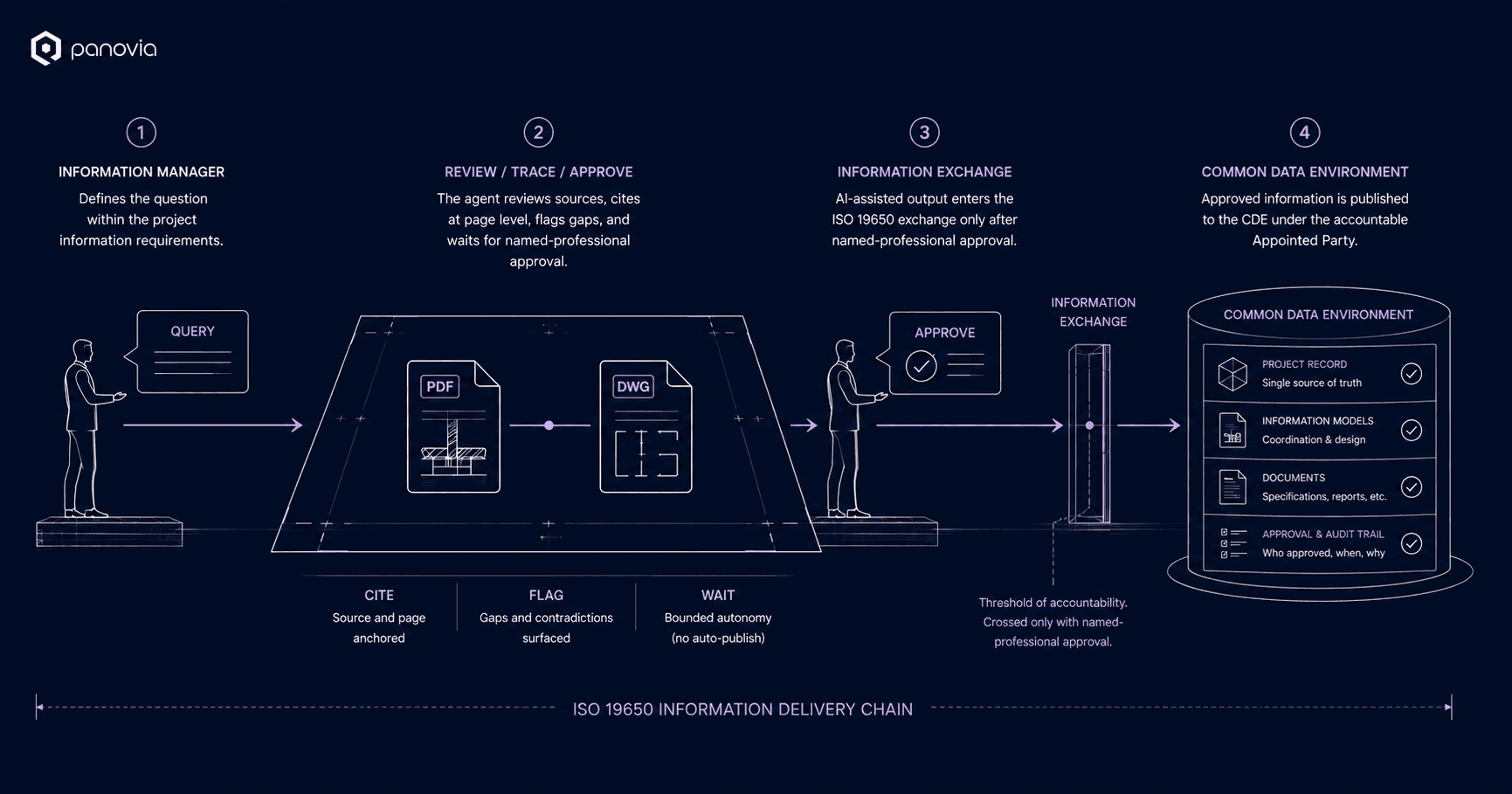
Three architectural properties have to hold for an AI tool to be safe inside the ISO 19650 chain.
Property 1: Citation anchored at source and page. Every output the agent produces traces back to the specific document and the specific page that produced it. When the audit asks “where did this Information Delivery Plan compliance statement originate”, the answer is structurally available at the moment of generation, not reconstructed from logs after the fact.
Property 2: Named-professional approval before CDE publication. The agent does not publish into the Common Data Environment on its own. A named professional from the responsible Appointed Party approves before publication. The agent's autonomy is bound to the analytical layer; the consequential delivery action is human-approved.
Property 3: Contradictions between sources surface, not collapse. Where two source items in the project record disagree, the agent surfaces both citations. The named professional resolves the contradiction. Architectures that average or guess silently are unsafe under audit because the audit eventually finds the contradiction.
A worked example: did the Information Delivery Plan commitments hold across Stage 4?
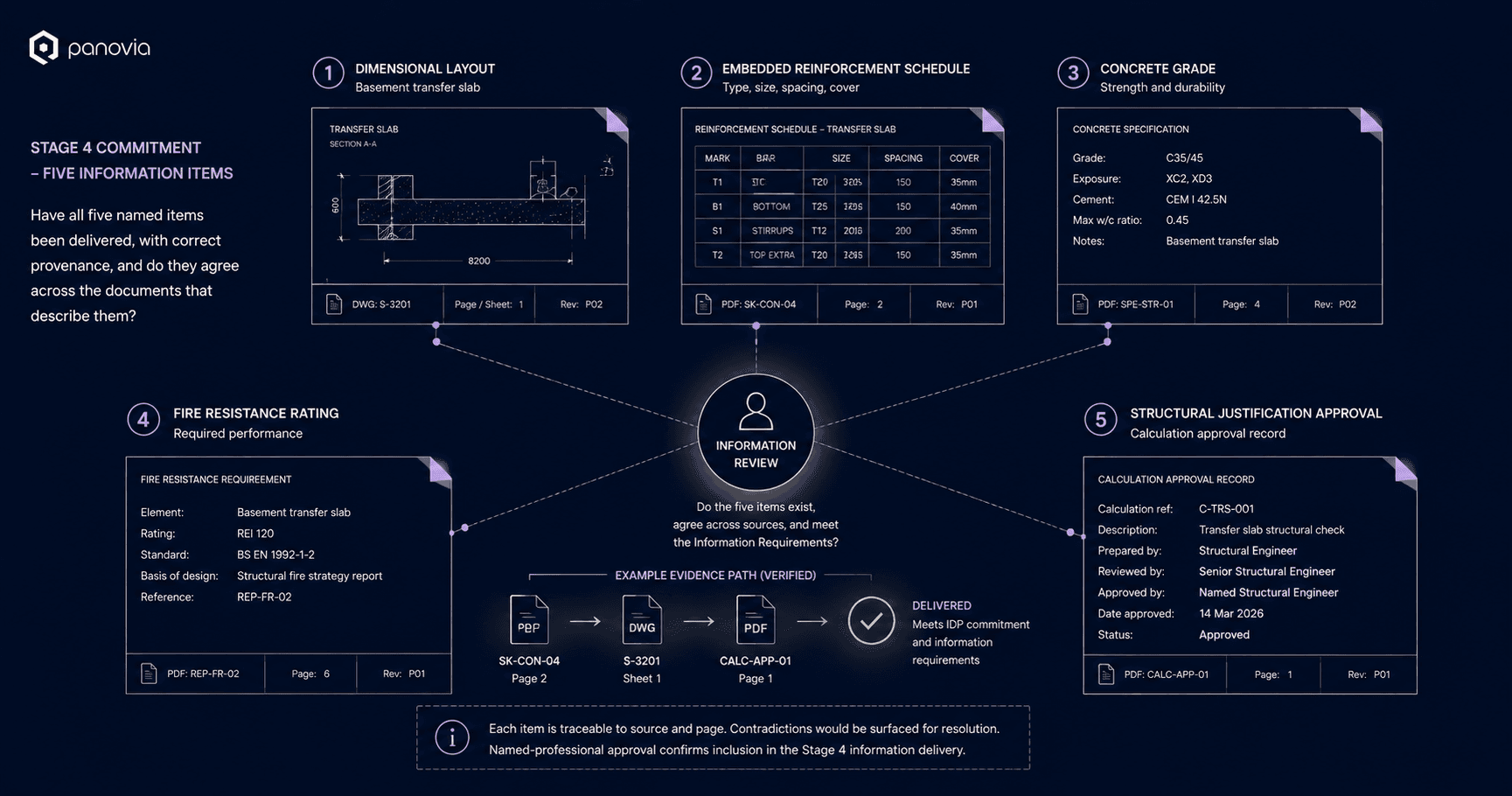
Take a specific ISO 19650 information delivery question on a UK higher-risk residential project. The Lead Appointed Party committed at Stage 3 that the Stage 4 information delivery would include five named items: the dimensional layout of the basement transfer slab, the embedded reinforcement schedule, the concrete grade, the fire resistance rating, and the approval record of the structural justification calculation.
Six months later at the Stage 4 information exchange, the question is: have all five named items been delivered, with the correct provenance, and do they agree across the documents that describe them?
Without an AI agent, the Information Manager works through the Common Data Environment manually. With an AI agent processing the relevant PDF specifications and DWG drawings, three things have to be true for the answer to be safe.
First, the agent has to anchor each item it finds to the specific document and page that contains it. “The embedded reinforcement schedule was delivered” is not enough. “The reinforcement schedule was delivered on page 2 of specification SK-CON-04 dated 14 March 2026, and on drawing CON-PL-04” is what the audit needs.
Second, where two information items disagree (the specification PDF page 2 shows one reinforcement specification, the corresponding DWG drawing shows another), the agent surfaces both. The Information Manager decides which is authoritative for the exchange.
Third, the Information Manager approves the exchange before any of it is published into the Appointing Party's receiving CDE. The agent contributes; the human delivers.
That is the operational test of the three architectural properties on one named ISO 19650 question. If the AI tool you are evaluating cannot pass that test on your own current project documents, it is not safe to use inside your information delivery chain.
How Panovia's architecture maps onto this
Panovia's framework, Human-to-Agent-to-Human Governance, is built around the three properties holding from the first line of code. The Beta version at panovia.ai runs on daily renewable credits (15 standard requests, 5 pro requests, both renewable every day) and lets you upload your own PDF and DWG files into one free project of up to five files. The first three pages of each file are processed by default at present. The architectural properties inside the free tier are identical to those that will sit inside the future paid tiers because they sit in the architecture rather than the feature configuration.
On the measurable side: Panovia scores more than 10 percentage points higher than Nomic on AEC-Bench, the public AEC document intelligence benchmark Nomic itself published (Panovia internal evaluation, June 2026; methodology at nomic.ai). The architectural commitments are not only structurally distinctive; they are measurably more accurate on the AEC document intelligence tasks the benchmark covers.
Common questions
Does ISO 19650 say anything explicit about AI?
Not yet. The standard was published before the current generation of AI agents. Its accountability, auditability and quality requirements apply to any tool inside the information delivery chain, including AI. The structural questions — where did this information originate, who approved it — apply identically.
Can an AI agent satisfy the named-professional approval requirement on its own?
No. ISO 19650 places accountability on named professionals from the Appointed Party. The agent contributes; the human accountability remains.
How do I evaluate whether an AI tool is safe for ISO 19650 work?
Apply the three architectural properties as a procurement test. Citation anchored at source and page, by construction. Named-professional approval gates on every external action. Contradiction surfacing rather than collapse. If the tool passes all three architecturally, not as configurable features, it is structurally compatible with the standard.
What is the difference between ISO 19650 work and Building Safety Regulator Gateway 2 work?
ISO 19650 governs how information is managed through the project lifecycle. Gateway 2 is the UK-specific design-stage regulatory review for higher-risk buildings under the Building Safety Act 2022. The BSR transitioned to a fully independent statutory body on 27 January 2026 with strengthened enforcement powers (Norton Rose Fulbright, January 2026). The two regimes are complementary. The Gateway 2 evidence reconstruction page is at panovia.ai/blog/gateway-2-evidence-reconstruction.
What can the Panovia Beta version do today?
Upload PDF and DWG files into one project of up to five files. Run cited chat queries against the project. The agent surfaces citations at page level, declines to publish into any external system without explicit human approval, and surfaces contradictions between source documents rather than collapsing them. The first three pages of each file process by default. The free Beta tier runs on daily renewable credits: 15 standard chat requests and 5 pro document-analysis requests per workspace per day, both renewable every morning. Top up if you need more.
Try the worked example on your own files
Request early access at panovia.ai. Upload your PDF specifications and your DWG drawings. Apply the three architectural properties to a real ISO 19650 question on your own project record. Daily renewable credits. Top up when you need to.
Request Early AccessTo follow the architectural argument
- Full argument: panovia.ai/blog/h2a2h-governance.
- Audit-defensible AI definitional reference: panovia.ai/blog/audit-defensible-ai.
- Gateway 2 evidence reconstruction: panovia.ai/blog/gateway-2-evidence-reconstruction.
- Subscribe to The Reliable Knowledge Layer at thereliableknowledgelayer.substack.com.