What this page is
This page is for Senior Experts, Economic Buyers, compliance and risk professionals at AEC firms procuring AI tools as the AI hallucination case law reaches AEC defendants and the professional indemnity insurance landscape restructures around AI exclusions. It defines AI hallucination as a structural property of certain AI architectures, names the three operational tests that prevent the failure mode, and explains why architectures that pass the three tests are procurement-defensible in the post-Cassata market.
All claims on this page are anchored to numbered sources at the bottom of the page.
What AI hallucination is
AI hallucination is the structural failure mode in which a generative AI system produces output that is factually invented rather than anchored to a real source. The output is fluent, professionally formatted, and superficially plausible. The content the output asserts does not exist in the data the AI was working from. The most common hallucination patterns identified across academic research are total fabrication (66% of catalogued cases), partial attribute corruption (27%), and identifier hijacking (4%).
Hallucination is architectural. It is not a bug to be patched in the next version of the model. It is what happens when an AI system is asked to produce output and has no architectural constraint requiring the output to anchor to a real source. Stanford's 2026 AI Index reports hallucination rates across 26 frontier models tested in evaluation studies ranging from 22% to 94% depending on task type. Even commercial legal AI tools hallucinate 17% to 34% of queries according to Stanford RegLab research.
Hallucination is not “AI being wrong sometimes.” It is “AI being confidently fluent about content that does not exist.” The two are different procurement problems.
Why the phrase is now operative
Three forces are converging through 2026 to make AI hallucination the operative procurement question for AEC firms.
First, the case law has reached AEC defendants. Cassata v Michael Macrina Architect, P.C. (2026 NY Slip Op 26014, Suffolk County Justice Linda Kevins, 27 January 2026) is the first AEC-adjacent AI hallucination case with a published sanctions chart precedent. The plaintiff alleged the architect's flawed design caused a residential collapse during framing at 945 Dune Road, Westhampton Dunes, on 24 January 2023. The defendant's law firm filed briefs containing inaccurate or non-existent caselaw citations alleged to be generated using artificial intelligence. The court issued a structured sanctions chart for AI hallucination conduct, the first such chart published by a New York state court. The Cassata chart has been cited as authority in subsequent decisions including Gully v Varghese (May 2026).
Second, the case law beyond AEC is accelerating. The Damien Charlotin database at HEC Paris Smart Law Hub catalogues 1,353 documented AI hallucination cases globally as of early 2026, accelerating from 719 incidents in January 2026. Sullivan and Cromwell apologised to a federal bankruptcy judge in April 2026 over an AI-hallucinated filing. US courts imposed over $145,000 in AI hallucination sanctions in Q1 2026 alone, with Oregon issuing a $110,000 penalty and Nebraska ordering the first indefinite license suspension in US history tied to AI hallucinations. The US Fifth Circuit imposed a $2,500 sanction on an attorney who used vLex Enterprise and Thomson Reuters CoCounsel, demonstrating that commercial enterprise AI tools provide no safe harbour.
Third, the professional indemnity insurance market has restructured around AI exclusions. The Insurance Services Office introduced standardised AI exclusion endorsement forms CG 40 47 and CG 40 48 effective 1 January 2026. Parallel exclusion language is appearing in Directors and Officers and Errors and Omissions policy forms across the US market. AIG, Great American and WR Berkley filed AI exclusions during 2026. In the UK, the Wren Insurance Association exits the architects' professional indemnity market on 1 July 2026 — the day this page publishes — removing one of the last meaningful capacity sources for cladding-related PI cover representing approximately 20% of UK profession total fee income.
These three forces together make AI hallucination not a research curiosity but a live procurement, audit and insurance question for AEC firms.
The three architectural tests that prevent hallucination
Three tests separate architectures that prevent hallucination structurally from architectures that allow it.
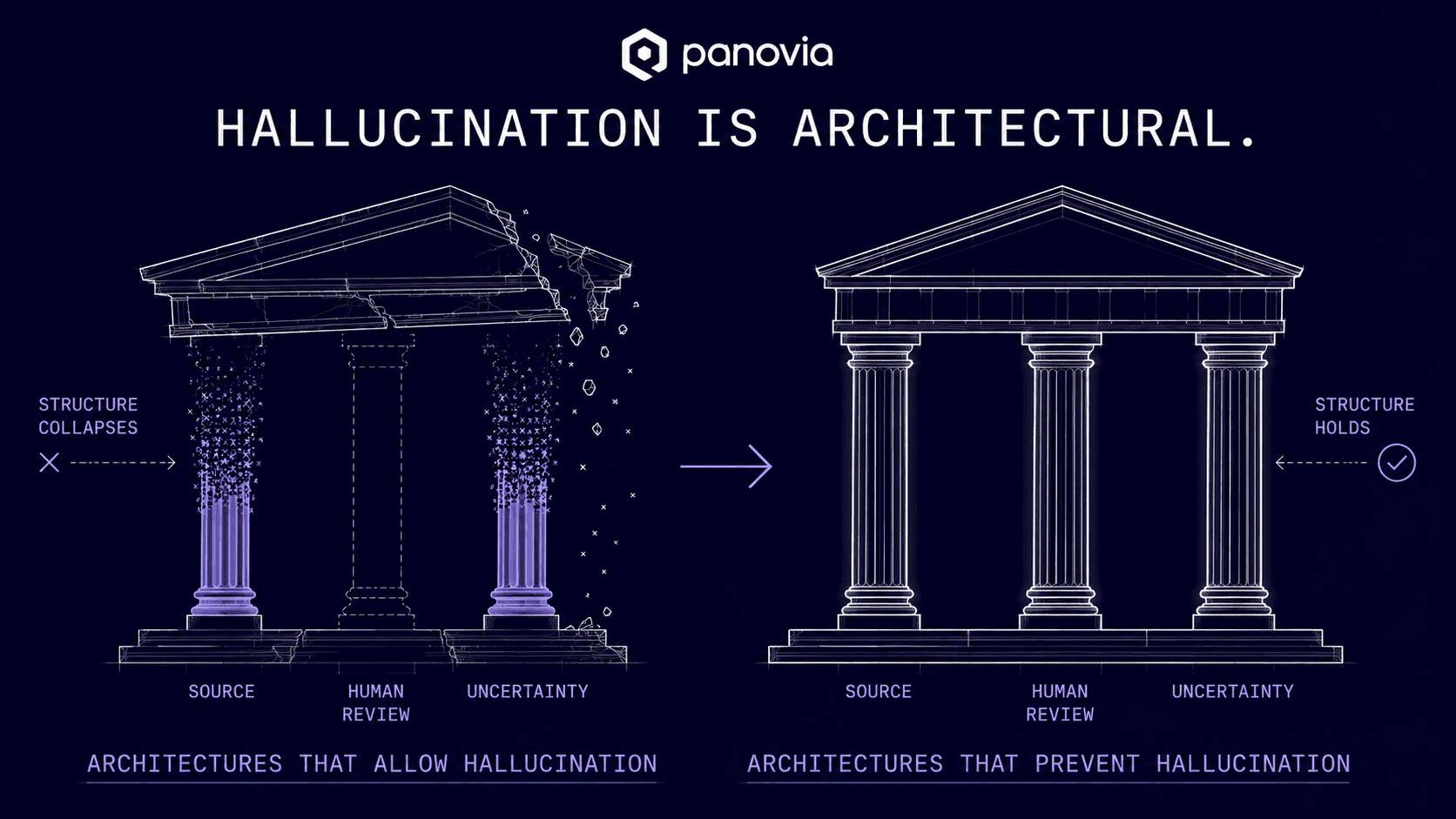
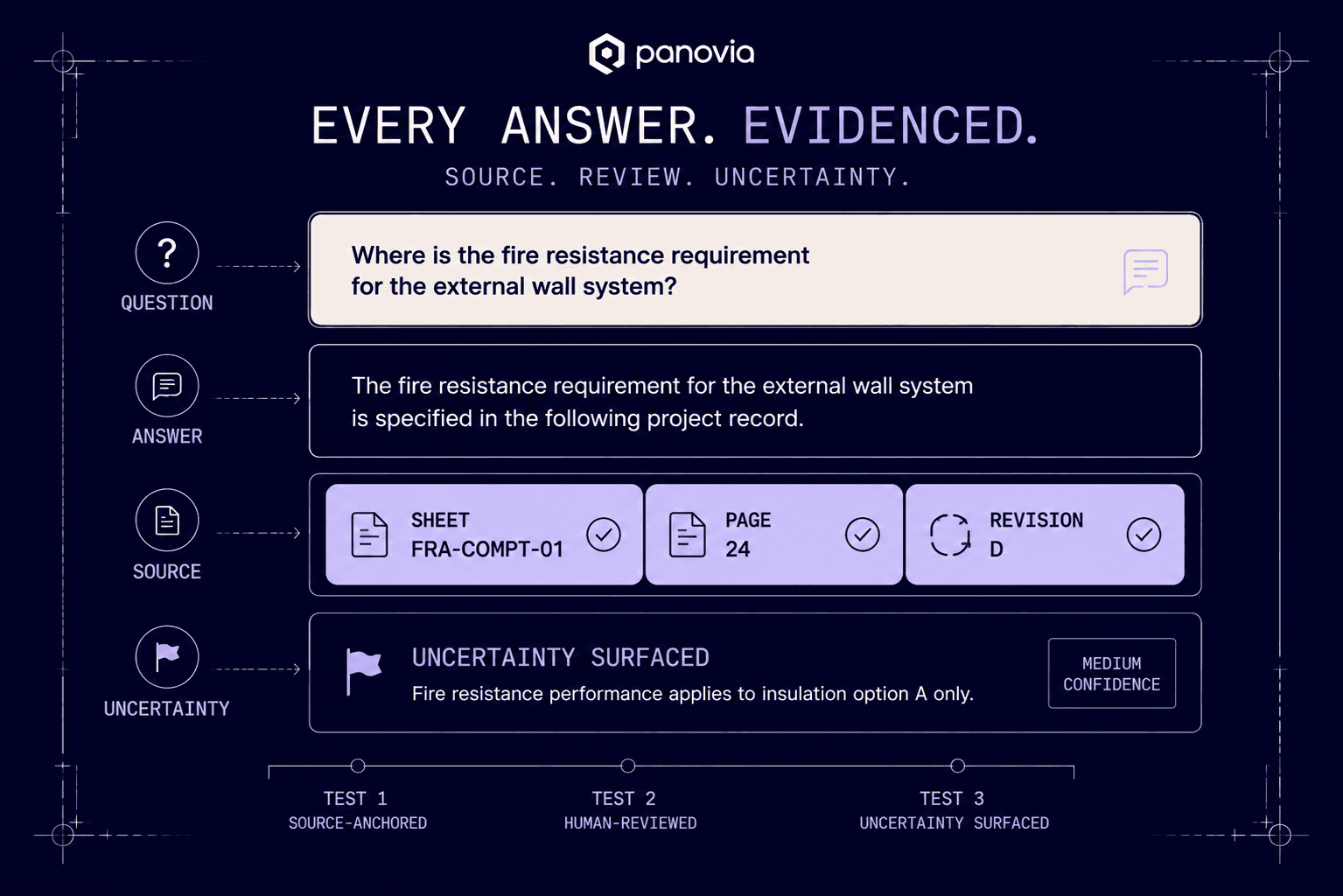
Test 1: Source-anchored citation at the moment of generation. Every output the agent produces is anchored to the specific document, page and revision that produced it. The citation exists at the moment the output is generated, not retrofitted from audit logs. When a PI insurer, BSR inspector or client procurement reviewer asks where the output originated, the answer is structurally available, not reconstructed.
An architecture that requires source citation at the moment of generation cannot hallucinate, because the architecture cannot produce an output without a real source to cite. Hallucination becomes architecturally impossible rather than merely discouraged.
Test 2: Named human approval before any external action. The tool does not deliver into the project information environment, the Common Data Environment, the client deliverable or any external system without a named professional from the responsible Appointed Party approving the action. The agent's autonomy is bounded to the analytical layer. The consequential delivery action is human-approved and named.
Architectures that require named human approval before external action add a structural review step between AI output and the project record. The named professional reviews the citation against the source. Hallucinated content cannot pass this gate because the citation does not check out.
Test 3: Surfaced uncertainty across sources. Where two source items in the project record disagree, the tool surfaces the contradiction rather than collapsing it into a single output. The named professional resolves the disagreement on the record.
Architectures that surface contradictions rather than collapse them cannot fabricate a synthesis that does not exist in the project record.
All three tests are architectural commitments, not configurable features.
They hold from the first line of code or they do not hold at all.
Where AI hallucination is most consequential in AEC
Five operational moments in AEC where AI hallucination carries the highest consequence.
First, building safety submissions. UK BSR Gateway 2 reviews approved 75% of applications in the 12 weeks to 30 May 2026 with 358 decisions and a 90% approval rate in the Innovation Unit. AI-assisted Gateway 2 submission content that contains hallucinated references to non-existent test methods, fabricated CDM record entries, or invented compliance evidence will be found in the forensic review at submission or in subsequent appeal.
Second, specification writing. AI-generated specification text routinely mixes US and European standards, invents non-existent ASTM test methods that follow standard numbering conventions, and creates RFIs and change orders when the testing lab cannot locate the fabricated method. ASTM International has issued an AI policy prohibiting entering ASTM standards into AI tools at the risk of the offending engineer losing library access.
Third, ISO 19650 information delivery. AI agents used to generate, review or assemble information delivered under ISO 19650 information exchanges produce work product the Appointed Party is responsible for. Hallucinated content embedded in Information Delivery Plan compliance statements or Asset Information Models reaches completion audit and creates the same architectural failure mode the Cassata defence created in court.
Fourth, professional indemnity disclosure. ISO endorsement forms CG 40 47 and CG 40 48 require AEC firms to disclose AI tool use on renewal. Hallucinated content in AI-assisted work product reaching client deliverables creates the procurement basis for an insurer to apply the AI exclusion. Wren's exit removes one capacity source from the UK market; the remaining insurers are scrutinising AI controls more strictly.
Fifth, litigation and dispute. Cassata establishes that AI-hallucinated content in legal submissions on behalf of an architect becomes part of the published sanctions record. The defendant law firm's tools become the architect's litigation problem.
What we are building, and how to test it on your own files
Panovia is purpose-built for AEC document intelligence with the three architectural tests holding from the first line of code. The Beta is live and free to start at panovia.ai. The pilot launches in a few weeks with deeper processing and broader scope. The architectural commitments are identical across Beta, pilot and beyond.
What the Beta does today: PDF and DWG, page-level citations on the opening pages of each document, one project per user, daily renewable query allowance. Project documents stay private to your workspace. We do not train on customer data.
What it does not do yet: deeper document processing, multi-project workflows, native integrations with the platforms your firm currently uses. All on the roadmap.
Test the architecture on your own files. Upload your PDF and DWG project files. Run the three architectural tests on a real project record. Daily renewable credits. Top up when you need to.
Common questions
What is the difference between AI hallucination and AI being wrong?
AI being wrong is the AI producing an answer that is factually incorrect but anchored to real sources. AI hallucination is the AI producing an answer that confidently fabricates sources that do not exist. The two are different procurement problems. AI being wrong is a model accuracy problem; AI hallucination is an architectural problem.
Does Cassata apply outside New York?
The Cassata sanctions chart was published by a New York state court and has direct legal effect only in New York. However, the case has been cited in subsequent New York decisions as authority and is referenced in compliance analyses across US jurisdictions. The underlying conduct — filing AI-hallucinated content in submissions — is sanctionable in every US jurisdiction under existing rules of professional conduct. Cassata's significance is precedential and editorial: the first published sanctions chart specifically for AI hallucination in a case involving an architect.
Can existing AI tools be retrofitted to pass the three tests?
Partially. Tools that already track citations to source documents have a foundation for Test 1. Tools that already require human approval on outgoing actions have a foundation for Test 2. Whether the foundation is sufficient depends on whether the test passes at architectural level — citation generated at the moment of output, approval required by structural commitment — or as a configurable add-on (citation retrofitted from logs, approval optional). Vendors that built around the three commitments from the first line of code start in a different procurement position from vendors retrofitting later.
What does the Wren exit mean for AI procurement in the UK?
Wren's exit removes approximately 20% of UK architectural profession fee income from the cladding-related PI market. The remaining UK insurers are scrutinising AI tool use on renewal more strictly. AEC firms procuring AI tools in the UK now face renewal questions about which AI tools have been used, what work product they produced, and what controls existed around hallucination risk. Tools that pass the three architectural tests are answerable; tools that do not are an insurance liability.
Does the ASTM AI policy apply to AEC AI tools generally?
The ASTM policy explicitly prohibits entering ASTM standards into AI tools. It does not prohibit AI tools that read project documents the engineer has authored or that the firm owns. Panovia operates against the firm's own DWG and PDF project files, which are the firm's information property. The architectural commitments to citation at source mean that ASTM content quoted within a firm's own project documents is cited back to the firm's own document rather than to a hallucinated copy of the ASTM standard. The ASTM policy and the three architectural tests are compatible by construction.
Test the architecture on your own files
The Beta is at panovia.ai. Upload your PDF and DWG project files. Run the three architectural tests on a real project record. Daily renewable credits. Top up when you need to.
Request Early AccessTo follow the architectural argument
- Full architectural framework: panovia.ai/blog/h2a2h-governance
- Gateway 2 evidence reconstruction reference: panovia.ai/blog/gateway-2-evidence-reconstruction
- Audit-defensible AI definitional reference: panovia.ai/blog/audit-defensible-ai
- ISO 19650 and AI agent compliance reference: panovia.ai/blog/iso-19650-ai-compliance
- AEC platform consolidation reference: panovia.ai/blog/aec-platform-consolidation
- Subscribe to The Reliable Knowledge Layer at thereliableknowledgelayer.substack.com
Sources
- 1. Cassata v Michael Macrina Architect, P.C., 2026 NY Slip Op 26014. Supreme Court of New York, Suffolk County, 27 January 2026. Justice Linda Kevins, JSC. law.justia.com/cases/new-york/other-courts/2026/2026-ny-slip-op-26014.html. Also reported at nycourts.gov/reporter/3dseries/2026/2026_26014.htm. Cited in Gully v Varghese, 2026 NY Slip Op 50864 (May 2026).
- 2. Charlotin, D. “AI Hallucination Cases Database.” HEC Paris Smart Law Hub, 2026. 1,353 cases globally as of early 2026, accelerating from 719 in January. Summary at compliancehub.wiki/legal-ai-hallucination-reckoning-2026/.
- 3. Sullivan and Cromwell public apology to federal bankruptcy court, April 2026. Reported across legal trade press; summary at compliancehub.wiki/legal-ai-hallucination-reckoning-2026/.
- 4. ComplianceHub. “The 2026 Legal AI Reckoning.” March 2026. compliancehub.wiki/legal-ai-hallucination-reckoning-2026/. Q1 2026 US sanctions exceeding $145,000 total. Oregon $110,000. Nebraska indefinite license suspension 15–16 April 2026 (attorney Greg Lake). US Fifth Circuit $2,500 (vLex / CoCounsel). US Sixth Circuit Whiting v City of Athens, Tennessee (March 2026) $15,000 per attorney.
- 5. Insurance Services Office endorsement forms CG 40 47 and CG 40 48, effective 1 January 2026. Source: Risk Specialty Group, January 2026. riskspecialtygroup.com/ai-liability-insurance-architects-2026/.
- 6. ASTM International AI policy, in force 2026. Source: Gausnell, O'Keefe and Thomas LLC, January 2026. gotlawstl.com/when-smart-tools-make-dumb-mistakes-ais-hidden-risks-in-construction-documents/.
- 7. BCIS. June 2026. bcis.co.uk/news/latest-building-control-approval-application-data/. 358 Gateway 2 decisions in 12 weeks to 30 May 2026; 75% approval. Innovation Unit 90%. Also: building.co.uk.
- 8. Wren Insurance Association. Press statement 24 March 2026. wrenmutual.co.uk. Architects Journal 26 March 2026: architectsjournal.co.uk. Building Design 13 April 2026: bdonline.co.uk.
- 9. Massenkoff, M. and McCrory, P. “Labor Market Impacts of AI.” Anthropic, 5 March 2026. anthropic.com/research/labor-market-impacts. AEC-lens interpretation: Monograph, April 2026. monograph.com/blog/ai-impact-architecture-engineering-firms.
- 10. Stanford HAI. “2026 AI Index Report, Responsible AI chapter.” 2026. hai.stanford.edu/ai-index/2026-ai-index-report/responsible-ai. 362 incidents in 2025 (55% YoY rise). 22–94% hallucination range across 26 frontier models. Stanford RegLab on commercial legal AI: 17–34% query hallucination rate.
- 11. Ansari (2026), “Compound Deception in Elite Peer Review.” arXiv:2602.05930.