What this page is
This page is for Senior Experts, Economic Buyers, compliance and risk professionals at AEC firms who have bought, or are about to buy, AI access, and who need to know why access alone is not producing results. It defines AI readiness, distinguishes it from AI literacy, and names the three architectural tests that make an AI tool procurement-defensible. All claims are anchored to numbered sources at the foot of the page.
The moment we are in
The largest contractor in the United States has given roughly 11,000 employees a ChatGPT licence, and its people have built more than 400 of their own agents.1 It is the clearest sign yet that AI in construction has moved from pilot to infrastructure. It is also widely misread. Those agents work because they run on the firm's own project data, in a controlled environment, with a person in the loop. That is the part a smaller firm cannot replicate by buying licences.
Literacy and readiness are not the same thing
AI literacy is giving people the tools and the skills to use AI. AI readiness is making your data structured, governed and trustworthy enough that those tools can answer from it, and that you can stand behind the answer. Literacy is a training and licensing exercise you can complete in a week. Readiness is a data exercise, and it cannot arrive on a single purchase order, because it is a condition you reach rather than a product you install. Most firms are being sold the first and quietly need the second.
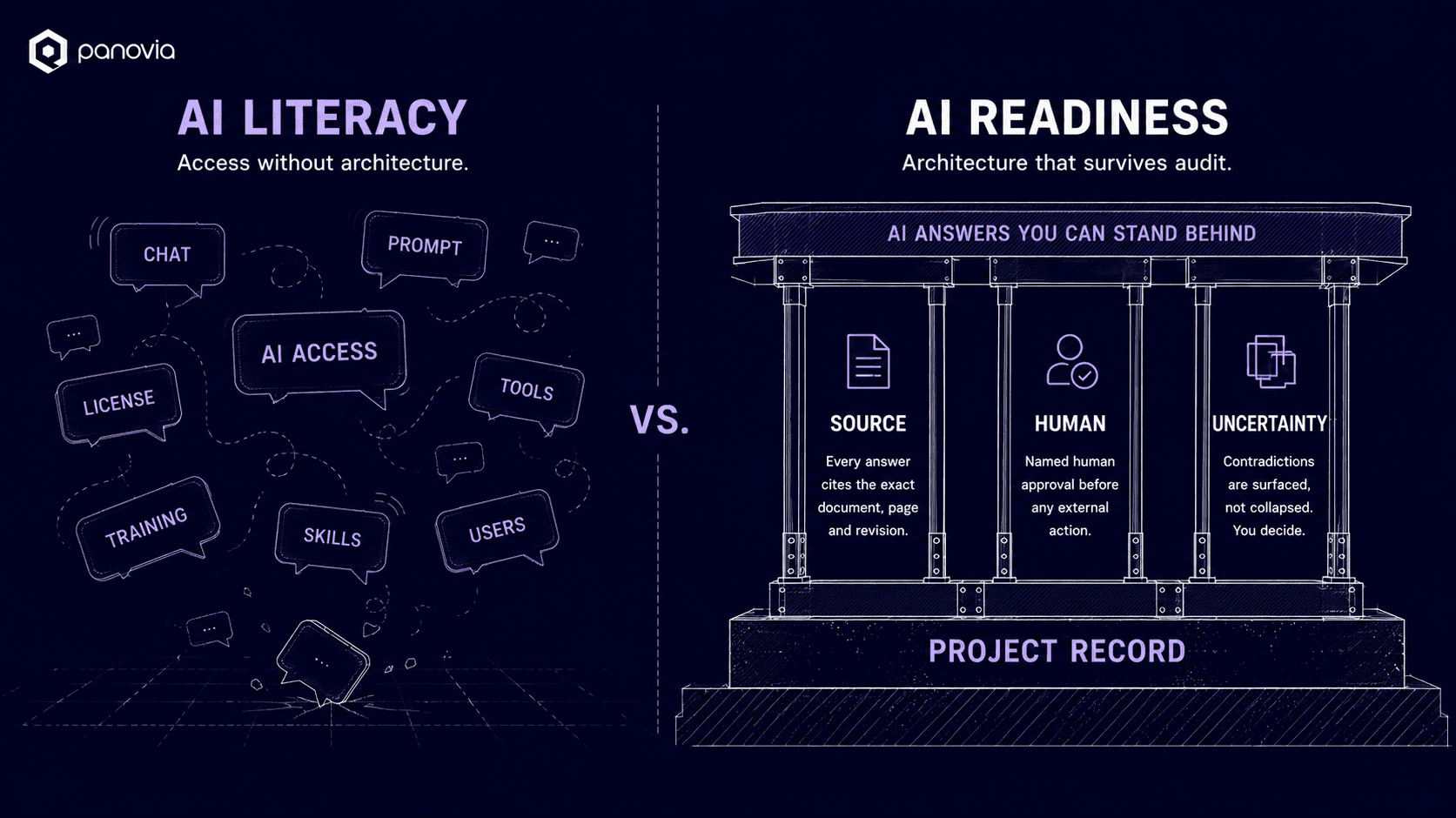
Why the difference is expensive in AEC
An AI answering from messy or contradictory project data will still answer, confidently. In most sectors a wrong answer is an inconvenience. On a construction project, where the average US dispute runs near 60 million dollars and usually begins with a misread obligation,2 a confident wrong answer is a liability with a number attached. Add the hallucination case law now reaching AEC defendants3 and the PI market restructuring around AI exclusion,4 and readiness stops being a productivity question and becomes a procurement and insurance one.
The market is already voting for the data layer
By one industry analysis, around 126 million dollars flowed into AEC document-intelligence startups in early 2026, aimed at structuring documents rather than building another chat interface, and incumbents are buying these companies rather than building them.5 Open benchmarks have appeared to test whether an AI can even read across a full drawing set correctly.6 Adoption figures, meanwhile, should be read with care: one 2026 survey puts AEC AI use around a quarter of firms,7 another near three-quarters.8 They disagree because they define using AI differently. The honest reading is that experimentation is widespread and dependable, data-backed use is not, which is precisely the gap Anthropic measured as the largest of any major industry.9
The three architectural tests that make a tool ready
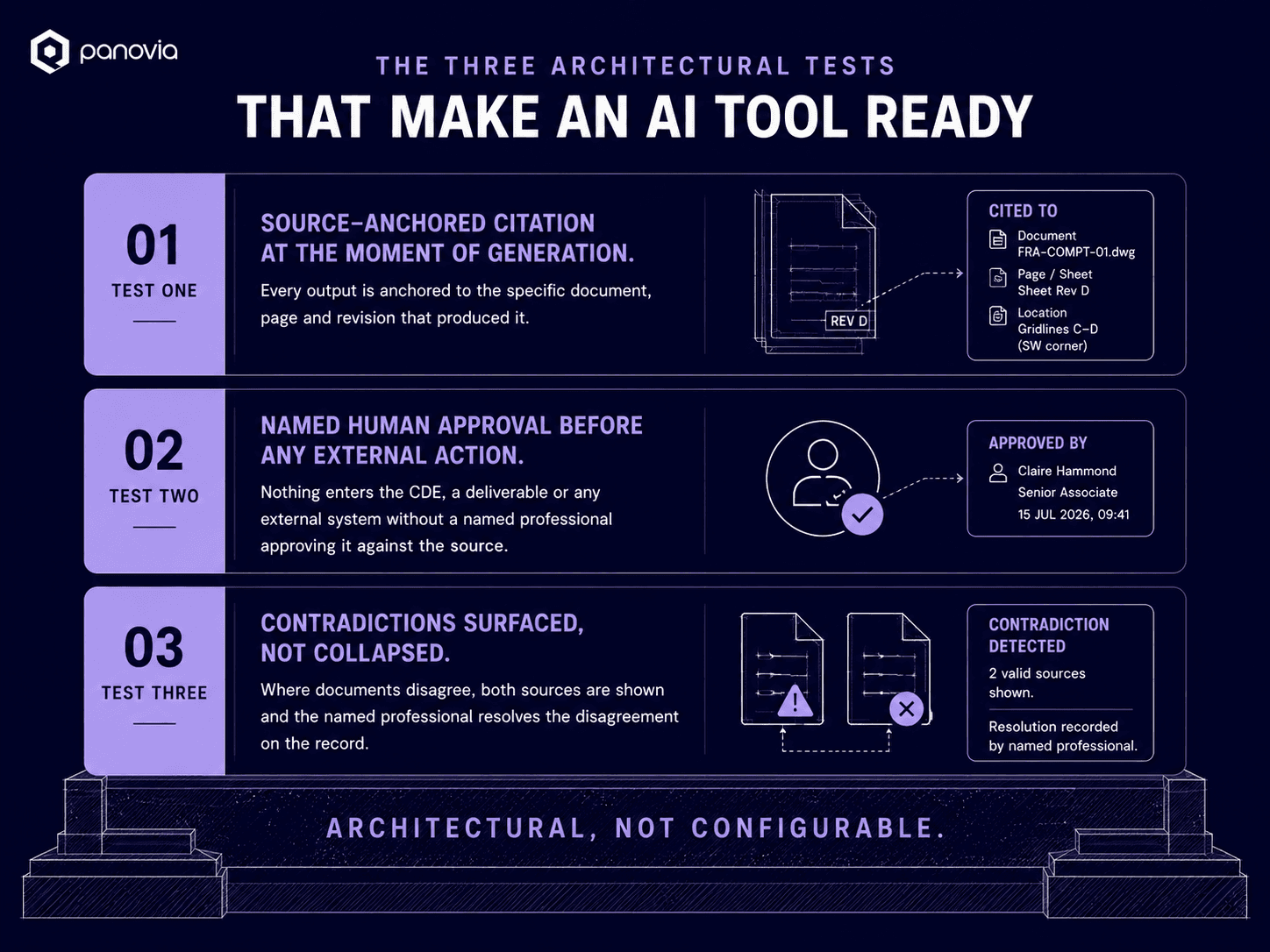
Readiness is not a mood or a mandate. It is three concrete commitments, and they are the same three that decide whether an AI answer survives an audit. All three are architectural, not configurable: they hold from the first line of code or they do not hold at all.
Test 1: Source-anchored citation at the moment of generation. Every output is anchored to the specific document, page and revision that produced it, at the moment it is generated, not retrofitted from logs. An architecture that requires a real source to answer cannot hallucinate, because it cannot produce an output without one.
Test 2: Named human approval before any external action. Nothing enters the project information environment, the CDE, a client deliverable or any external system without a named professional approving it against the source. Hallucinated content cannot pass this gate, because the citation does not check out.
Test 3: Contradictions surfaced, not collapsed. Where two real documents disagree, both citations stand and the named professional resolves the disagreement on the record. The agent does not invent a synthesis that does not exist in the project record. This is the H2A2H Governance idea: human to agent to human, at both ends of any consequential step.
All three are architectural, not configurable.
They hold from the first line of code or they do not hold at all.
Where readiness is most consequential in AEC
Building safety submissions. Gateway 2 content with hallucinated references to non-existent test methods or fabricated compliance evidence will be found in forensic review.10
Specification and standards. AI-generated specification text routinely invents plausible-looking standard numbers; readiness means the citation traces to the firm's own document, not a fabricated copy.
ISO 19650 information delivery. Hallucinated content embedded in delivered information reaches completion audit as the Appointed Party's responsibility.
PI renewal and disputes. Post-Wren, UK insurers are scrutinising AI use on renewal;4 an answer you can trace is answerable, one you cannot is a liability.
A readiness check you can run this week
If any of the three is hard, the gap is not your AI. It is your data readiness. That is fixable, and it is the right place to start.
What we are building, and how to test it
Panovia is built for AEC document intelligence with the three tests holding from the first line of code. The beta is open to everyone at app.panovia.ai, no waitlist or request form, free to start: PDF and DWG, page-level citations on the opening pages of each document, one project per user, a daily renewable query allowance, private workspace, no training on customer data. Deeper processing, multi-project workflows and integrations are on the roadmap; the MVP launches in the coming weeks with deeper processing and broader scope. The architectural commitments are identical across Beta and MVP.
Common questions
What is AI readiness in construction?
The state in which a firm's project data is structured, governed and traceable enough for AI tools to produce accurate, source-linked answers a person can stand behind.
Is readiness the same as digital transformation?
No. Digital tooling puts work into software. Readiness makes the data inside and around that software usable and defensible for AI. A firm can be heavily digitised and still not AI-ready.
Do we need to move all our data onto one platform first?
No. Readiness can be reached neutrally, across the tools you already use, without migrating onto a single vendor and without handing over ownership of the result.
How is this different from giving staff ChatGPT?
That is literacy. It does nothing about the quality, structure or traceability of the data the tool draws on. Readiness is the data work underneath.
How do I try it?
The beta is open to everyone at app.panovia.ai. No waitlist, no request form; free to start, with a daily renewable query allowance.
Run the readiness check on your own files
The beta is open to everyone at app.panovia.ai. No waitlist, no request form. Upload your PDF and DWG project files and run the three architectural tests on a real project record. Free to start, with a daily renewable query allowance.
Try the BetaTo follow the argument
- Full architectural framework: panovia.ai/blog/h2a2h-governance
- Audit-defensible AI definitional reference: panovia.ai/blog/audit-defensible-ai
- AI hallucination in AEC work product reference: panovia.ai/blog/ai-hallucination-aec-work-product
- AEC platform consolidation reference: panovia.ai/blog/aec-platform-consolidation
- Subscribe to The Reliable Knowledge Layer at thereliableknowledgelayer.substack.com
Sources
- 1. Construction Dive. “Turner unveils ‘wall to wall’ partnership with OpenAI.” constructiondive.com/news/turner-partnership-openai-startups-tech. Also: Global Construction Review, “Turner gives every employee ChatGPT Enterprise.” globalconstructionreview.com. Approximately 11,000 employees; more than 400 employee-built agents running on the firm's own project data.
- 2. Arcadis. “2025 Global Construction Disputes Report” (15th annual), June 2025. arcadis.com. Average US dispute value $60.1 million; failure to understand and/or comply with contractual obligations among the most common causes.
- 3. Cassata v Michael Macrina Architect, P.C., 2026 NY Slip Op 26014. Supreme Court of New York, Suffolk County, 27 January 2026. law.justia.com. Full treatment: panovia.ai/blog/ai-hallucination-aec-work-product.
- 4. Insurance Services Office AI exclusion endorsement forms CG 40 47 and CG 40 48, effective 1 January 2026. riskspecialtygroup.com. Wren Insurance Association exit from the architects' PI market, 1 July 2026: architectsjournal.co.uk.
- 5. AEC Foundry. “AI Can't Read Your Drawings — Inside the Race to Build AEC's Knowledge Layer.” 2026. aecfoundry.com. Approximately $126M into contech startups in early 2026, pointed at documents; incumbent acquisitions including Trimble–Document Crunch.
- 6. AEC-Bench, a multimodal benchmark for agentic systems on real AEC documents: 196 task instances spanning single-sheet, cross-sheet and cross-document reasoning. github.com/nomic-ai/aec-bench. Also AECV-bench on architectural floorplans: aecfoundry.com.
- 7. Bluebeam. AEC AI adoption report: 27% of AEC firms use AI for automation, problem-solving or decision-making. press.bluebeam.com.
- 8. Unanet. “2026 AEC Inspire Report.” 75% of AEC firms report using AI; only 29% report high confidence in the underlying data. prnewswire.com.
- 9. Massenkoff, M. and McCrory, P. “Labor Market Impacts of AI.” Anthropic, 5 March 2026. anthropic.com/research/labor-market-impacts. Architecture and engineering: roughly 85% theoretical AI task exposure against approximately 5% observed usage, the largest gap of any major industry studied. AEC-lens interpretation: monograph.com.
- 10. BCIS. “Latest Building Control Approval Application Data.” June 2026. bcis.co.uk. 358 Gateway 2 decisions in the 12 weeks to 30 May 2026; 75% approval rate.