Autodesk and Procore are building project-aware agents. The next requirement is a decision thread that survives the boundary between platforms.
Software is getting more capable inside its own walls. The project still lives across all of them.
For several years, the AI question in architecture, engineering and construction was whether a machine could find the right thing in a very large pile of documents.
It was a reasonable question. The industry has many very large piles.
This week, the question changed.
On 15 September, Autodesk previewed agentic AI across Forma, Fusion and Flow. Its next-generation Assistant is intended to understand project context, determine what needs attention and act across workflows. In June, Procore announced a connected Common Data Environment designed to support agentic AI coworkers across BIM, documents, quality and assets.
The market is moving from answers to action.
In brief: AI agents in AEC can now interpret project context and act inside connected workflows. As each platform becomes more intelligent, projects need a portable decision memory that preserves evidence, intent, authority, impact and proof of arrival across the systems and organisations where the work lives.
Project-aware is the new baseline
Autodesk's announcement matters because it describes an assistant that understands the project rather than merely the prompt. One example follows a structural change through fabrication, schedule, cost, sequencing and operations. The company also plans to let customers bring their own intelligence through Assistant Builder, with support for third-party agents planned.
Procore's direction is similarly clear. Its CDE is designed to connect models, drawings, specifications, RFIs, submittals and field activity so agents can do more than retrieve information. The company describes AI that can identify discrepancies, recommend next actions and execute work while keeping source attribution visible and final decisions with project teams.
| Date | Development | What it signals |
|---|---|---|
| 15 September 2026 | Autodesk previewed agentic AI across Forma, Fusion and Flow, with an Assistant designed to understand project context and act across workflows. | Design and delivery platforms are moving from retrieval to action. |
| June 2026 | Procore announced a connected Common Data Environment built to support agentic AI coworkers across BIM, documents, quality and assets. | Field and commercial platforms are building the same project-aware layer. |
This is an important advance. A project is not a folder with deadlines. It is a changing system of commitments.
When an AI can perceive more of that system and act within it, the possible value grows sharply.
So does the size of a mistake.
The new fragmentation will be intelligent
The difficult part is not that agents will be unintelligent. It is that they will be intelligent in different places.
- A design agent may understand the revised model.
- A planning agent may understand the programme.
- A commercial system may understand the cost exposure.
- A document environment may hold the approved record.
The client, architect, contractor and consultant may each have a different boundary of authority.
For years, project fragmentation meant that information was scattered across files and systems. The next form is subtler. Each platform may become highly intelligent about the slice of reality it can see.
That local intelligence is valuable. It still leaves the project with a cross-platform question: can the reasoning and authority behind a decision travel as reliably as the changed data?
This is not a case for one giant application. It is a case for a portable decision memory.
A small change with a large shadow
Consider a structural grid adjustment late in design.
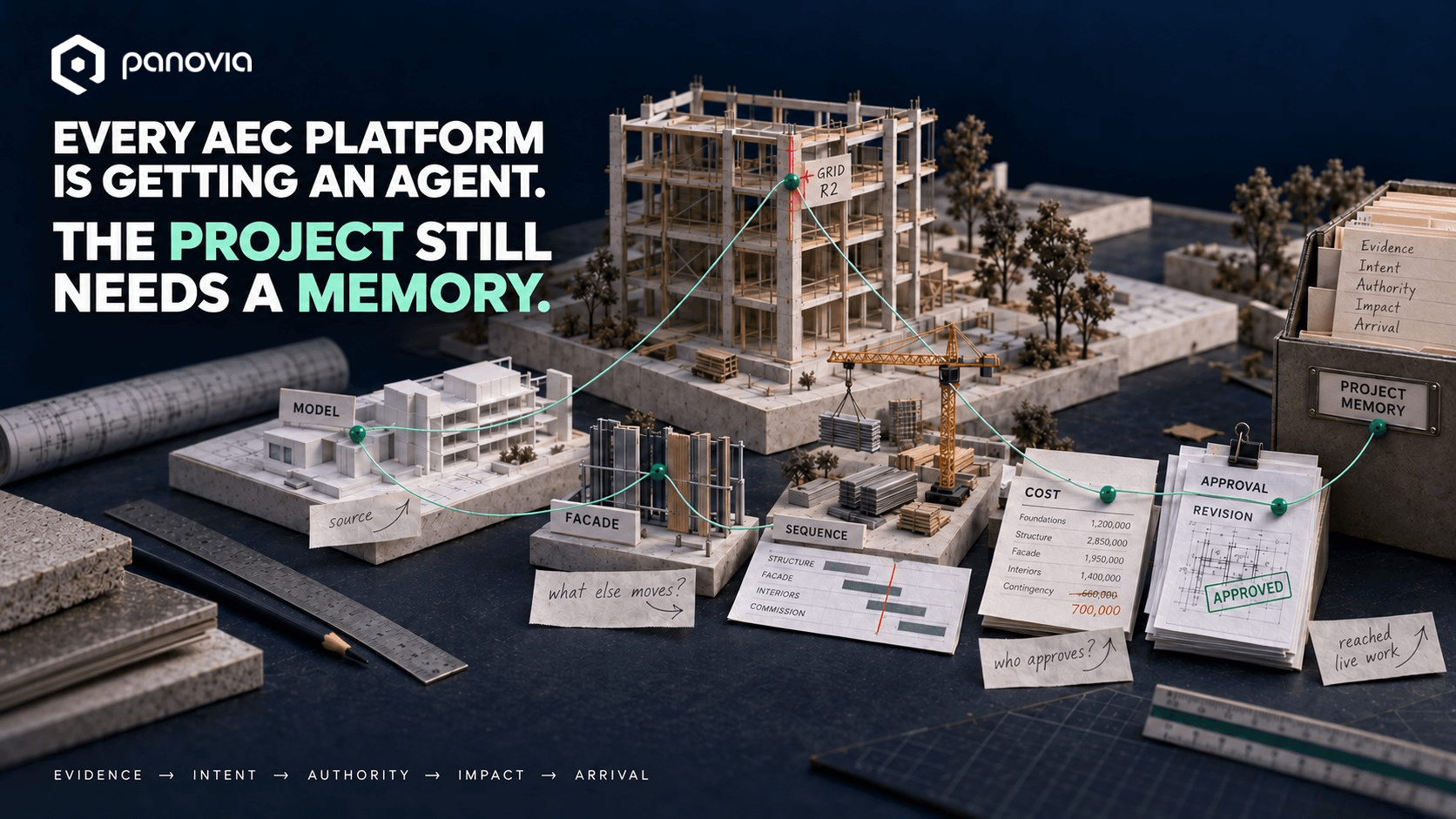
The geometry changes in the model. A façade package now needs review. A penetration strategy may be affected. A supplier's fabrication window may move. A planning sequence no longer fits its previous assumption. A cost allowance is reopened. The client commitment attached to a milestone becomes less certain.
No single one of those consequences is the project.
Together, they are the project.
An agent that identifies the first effect is useful. An agent that drafts the RFI is useful. An agent that updates a schedule may also be useful. But the project still needs to know:
- which source triggered the change;
- which revision is authoritative;
- what else may be affected;
- who is entitled to decide;
- what was approved;
- and whether the decision reached every live plan and responsibility.
This is the coordination layer between intelligence and delivery.
What a portable project memory requires
"Project intelligence" risks becoming one of those phrases that can mean anything while appearing to mean a great deal. A useful definition is stricter.
Project intelligence is the ability to preserve how changing evidence became an authorised decision, which consequences followed and whether the approved change reached the live work.
That requires a five-part decision thread.
| Element | What must remain legible |
|---|---|
| Evidence | Which source, revision and observation triggered the change? |
| Intent | What outcome was the team trying to protect or improve? |
| Authority | Who was entitled to approve the consequence? |
| Impact | Which plans, dependencies, risks and responsibilities had to move? |
| Arrival | Do the relevant plans, owners and downstream work reflect the decision — and can the team prove it? |
In the grid-adjustment scenario above, the revised model is the evidence. Protecting the fabrication window and the client's completion date is the intent. The structural engineer or delivery lead holds the authority. The façade package, penetration strategy, supplier window, sequence and cost allowance form the impact. The decision is only real once the schedule, cost plan and supplier brief show it — that is arrival.
CDEs matter, but the project exceeds any one system
The connected CDE is becoming a foundation for agentic AEC, and rightly so. Verified project data is better ground for action than a general model searching a miscellaneous cloud drive.
But most complex projects will remain plural. They have multiple organisations, contractual boundaries, models, schedules, communication tools and systems of record. Their truth is distributed partly because their accountability is distributed.
The strategic question is therefore not which application will own every fact. It is how the project will preserve a reliable decision thread across the facts that remain elsewhere.
This is related to the idea we explored in Why AI Project Management Needs a World Model. A project system should not only retrieve content. It should maintain a changing representation of relationships, decisions and consequences.
Where Panovia fits
Panovia is being built as an AI environment for project planning and delivery. It connects changing inputs to their potential effects across plans, dependencies, risks, decisions and responsibilities.
It is not an attempt to replace the authoring tools, CDEs or specialist systems where project work lives. Those systems are valuable. Panovia's role is to help the project remain coherent across them.
The operating principle is simple:
- sources remain visible;
- uncertainty is surfaced;
- consequential actions require named human approval;
- affected work is shown before change is accepted;
- and nothing is silently deleted from the project's memory.
We describe this as Human-to-Agent-to-Human governance. The agent does the work of finding connections and preparing a path forward. A person retains the authority to decide what becomes real.
The next competitive advantage
AEC software is entering a more consequential phase. Retrieval made information easier to find. Generation made material easier to produce. Agents will make action easier to initiate.
The next advantage will come from making decisions portable without stripping them of context.
That is good news for the industry. It moves the centre of gravity away from novelty and towards delivery. But it also gives technology leaders, architects, BIM managers and project directors a new test for every agentic promise:
Can the project retain not only what the agent did, but why, under whose authority, what else it affected and whether the change arrived when that record crosses a platform boundary?
If it cannot, the project has automation. It does not yet have project intelligence.
Every platform may gain an agent.
The durable advantage will belong to the project that retains a memory.
Plan it. Run it. Prove it.
Bring the platforms you already use. Panovia keeps the decision thread connected as the project moves between them.
See how Panovia keeps evidence, authority, impact and arrival connected across every platform your project touches.Frequently asked questions
What is agentic AI in AEC?
Agentic AI in AEC refers to AI systems that can interpret project context, plan steps, recommend actions or execute work across design, construction and operational workflows, rather than only answering isolated questions. Recent moves by Autodesk and Procore show major platforms building this capability directly into design, field and commercial workflows.
How is agentic AI different from generative AI in construction?
Generative AI mainly creates or summarises content. Agentic AI can pursue a goal across multiple steps and tools. In a project context, that may include detecting a change, assessing implications, preparing actions and updating a workflow subject to defined permissions. The practical difference is action: agentic systems are built to change the state of the work, not only describe it.
What is project intelligence?
Project intelligence is the ability to preserve how changing evidence became an authorised decision, which consequences followed and whether the approved change reached the live work. It requires a decision thread — evidence, intent, authority, impact and arrival — that survives the boundary between platforms and organisations.
Will AI agents replace CDEs or BIM platforms?
Not necessarily. CDEs and BIM platforms provide authoritative data and specialist workflows. Agents can make that information more actionable, while a coordination layer can help preserve evidence, decisions and dependencies across systems and organisations. Most complex projects will remain plural, so the more useful question is how a reliable decision thread survives across the systems that remain.
Why does human approval still matter?
Complex projects distribute contractual and professional authority across named people and organisations. Human approval keeps consequential changes aligned with that authority and creates a defensible record of why the project changed. Panovia treats this as Human-to-Agent-to-Human governance: the agent proposes, and a named person decides what becomes real.
Sources
- Autodesk, Autodesk Advances Agentic AI Across Its Three Industry Clouds, 15 September 2026.
- Procore, Procore Redefines the Common Data Environment With Connected Data and Agentic AI, June 2026.
- Panovia, The World Model Solution: Moving Beyond Static Digital Paper in Project Operations.
- Panovia, H2A2H Governance: AI Trust Architecture for Construction.