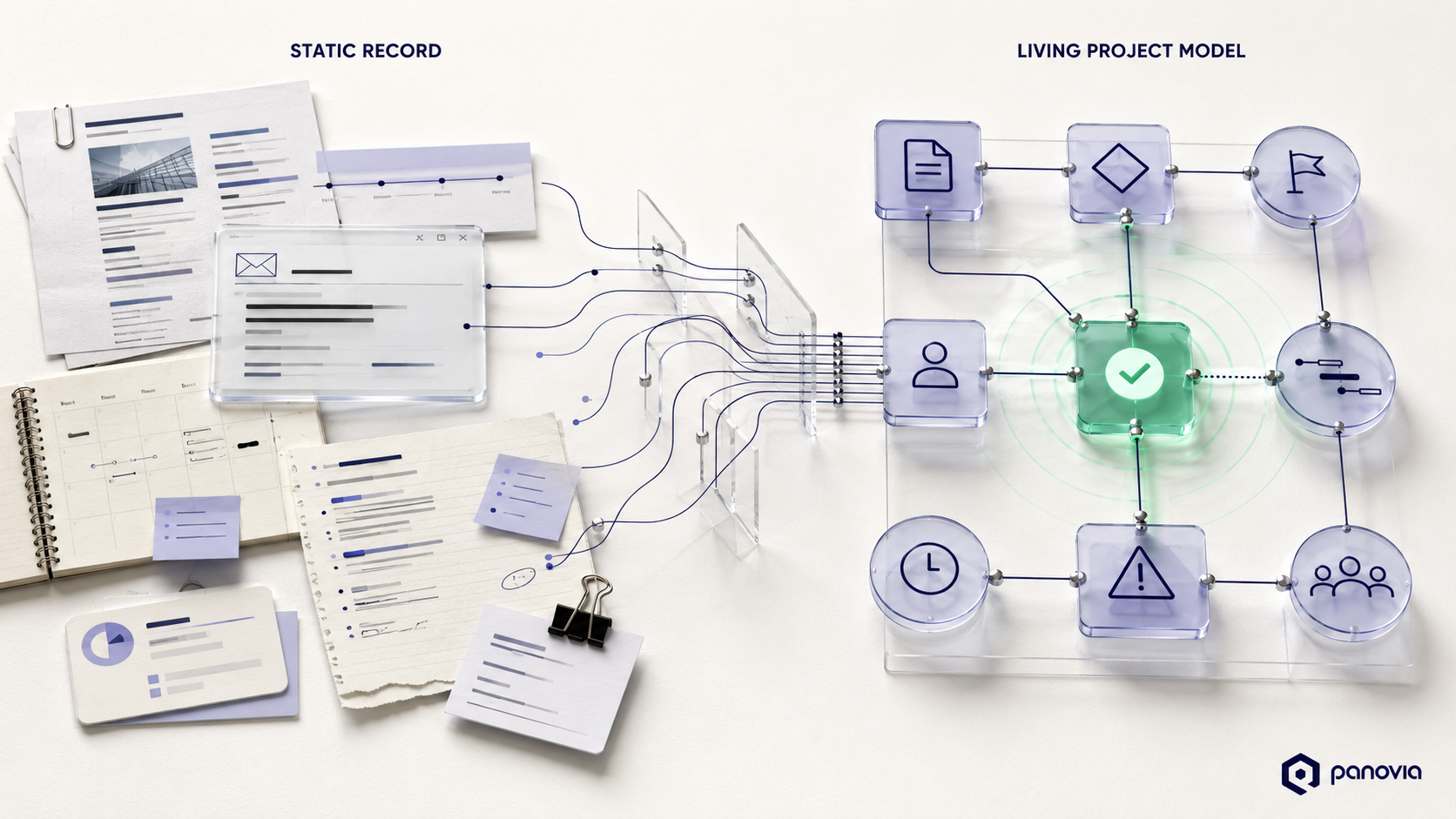
If you have managed complex technical initiatives over the last two decades, you are familiar with the fundamental irony of project management tools.
We spend millions on software designed to track work, yet our platforms act as static digital paper. They record decisions long after they occur, while the actual negotiation of trade-offs, scope, and technical strategy happens elsewhere: in chaotic chat threads, unrecorded video calls, and private emails. The board reflects a history of what went wrong rather than an active model of what comes next.
When Large Language Models (LLMs) arrived, technology leaders hoped conversational AI would solve this. We were promised that AI assistants could digest our communications and handle operational planning.
Instead, a sharp reality set in: Standard language models are fundamentally incapable of managing complex projects.
An LLM predicts the next word in a sentence based on statistical probability. It does not possess an internal model of reality. It does not understand state. It cannot calculate causality - how a two-day delay in database migration cascades into a broken compliance deadline three months down the line. Text generators yield fluent prose, but project execution demands deterministic logic.
To move beyond the limitations of text prediction, enterprise technology is shifting toward a foundational concept in physical AI: The World Model.
What is an Enterprise AI World Model?
In robotics and spatial computing, a world model is an internal simulation system. Pioneered by computer scientists like Yann LeCun through architectures like Joint Embedding Predictive Architecture (JEPA), world models allow an AI agent to predict how its environment changes when an action is taken.
When applied to project management, an AI World Model is a living, structured representation of your business context, operational constraints, and technical dependencies.
Unlike static boards or read-only text summaries, a project world model relies on three architectural pillars:
1. Dynamic State Tracking (Beyond Vector Search & RAG)
Traditional Retrieval-Augmented Generation (RAG) simply pulls text chunks from a vector database in response to a prompt. It treats documents as isolated assets.
An AI World Model builds a continuous semantic graph of the enterprise. It maps relationships between developers, codebases, deliverables, resource bandwidth, and strategic milestones. When a detail updates, the state shifts across the entire system.
2. Causality and Impact Simulation
Because a world model maintains state, it can simulate downstream effects. If a technical lead flags a scope expansion in an engineering brief, the world model calculates the ripple effect on budget, timeline, and risk profile before the team commits to the change.
3. Historical Decision Lineage
Organizations waste thousands of hours repeating past mistakes because operational context disappears over time. A world model captures the rationale behind choices, anchoring live work to original specs, emails, and briefs.
The AI Bottleneck: The Enterprise Governance Deficit
The urgency for autonomous orchestration is clear. Enterprise adoption metrics highlight a massive shift in how software is built and deployed:
-
Massive Adoption: Industry research from Gartner predicts that 40% of enterprise applications will feature task-specific AI agents by the end of 2026, up from under 5% in 2025.
-
Proven Return on Investment: Analytics from IDC show that high-performing AI implementations yield an average 3.7x return per dollar invested.
Yet enterprise adoption faces a critical bottleneck: The Trust Deficit.
Additional research from Gartner reveals that over 40% of agentic AI deployments are at risk of cancellation due to governance failures, black-box execution, and a lack of data transparency. Engineering directors and operations leaders cannot trust an unvetted, autonomous agent to change project baselines without oversight. When an AI system acts without explicit evidence, enterprise teams reject it.
How Panovia Solves the Trust Gap: Propose-Confirm-Materialise
Panovia bridges the gap between static management tools and autonomous AI agents through a human-in-the-loop framework designed for strict auditability.
Instead of allowing an AI system to silently modify project plans, Panovia operates via a Propose-Confirm-Materialise lifecycle:
Step 1: Propose
When raw information arrives - a client email, a product brief, or an emergency Slack thread—Panovia’s world model evaluates the input against the current project graph. It simulates necessary schedule adjustments, identifies resource bottlenecks, and generates a structured change proposal.
Step 2: Confirm
Panovia presents the proposal to project leaders accompanied by explicit confidence scores and inline citation tags linking directly to source documents. Human judgment remains the ultimate filter.
Step 3: Materialise
Once confirmed by a human lead, the update is materialised directly into the project state - updating timelines, alerting stakeholders and reallocating tasks deterministically.
Real-World Scenario: Resolving a Critical Dependency
To understand how an AI World Model functions in practice, consider a scenario involving an enterprise SaaS release:
-
The Event: A third-party security vendor emails an engineering manager stating that an authentication audit will be delayed by 10 days.
-
Traditional Tool Failure: The email sits in an inbox. The project board remains green. Two weeks later, the team missed the public product launch.
-
Panovia’s Execution: The world model ingests the communication, maps the dependency to the product launch date, and flags a critical schedule conflict. It proposes pushing the public release date by 7 days while shifting QA resources to a non-blocked module. The manager receives a clear notification with source links, reviews the evidence, and clicks Confirm.
The project memory updates instantly, preserving complete governance.
The Future of Project Memory and Execution
We are entering a new era of enterprise operations. The era of static digital paper - where project tools merely observe human activity after the fact - is ending.
The future belongs to systems built on AI World Models: tools that maintain a continuous, source-backed understanding of work, anticipate operational friction, and empower humans to make decisions grounded in transparent evidence.
By combining deep semantic context with strict human oversight, organizations can move past unvetted chat bots and unlock the true potential of agentic execution.
Frequently Asked Questions (FAQ)
What is the primary difference between an LLM chatbot and an AI World Model?
An LLM chatbot predicts the next token in a text sequence based on statistical patterns without maintaining an internal model of state. An AI World Model maintains a dynamic, interconnected graph of your operational environment, enabling it to simulate cause-and-effect, track dependencies, and evaluate the downstream impact of decisions.
How does an AI World Model prevent hallucinations in project workflows?
Panovia eliminates hallucinations by enforcing a Propose-Confirm-Materialise architecture paired with source-backed evidence trails. Every proposal generated by the AI includes explicit confidence indicators and direct inline citations to underlying source files, ensuring human managers verify actions before execution.
Why is static digital paper a problem for modern project management?
Traditional software acts as static digital paper because it requires manual human updates after work occurs. This creates a disconnect between real-time team discussions, which happen in chat or meetings, and the project board, leading to outdated status reports and unexpected project delays.