A policy can define the rule. It cannot update the dependency, route the approval or prove the decision reached the work.
A policy describes control. A project has to perform it.
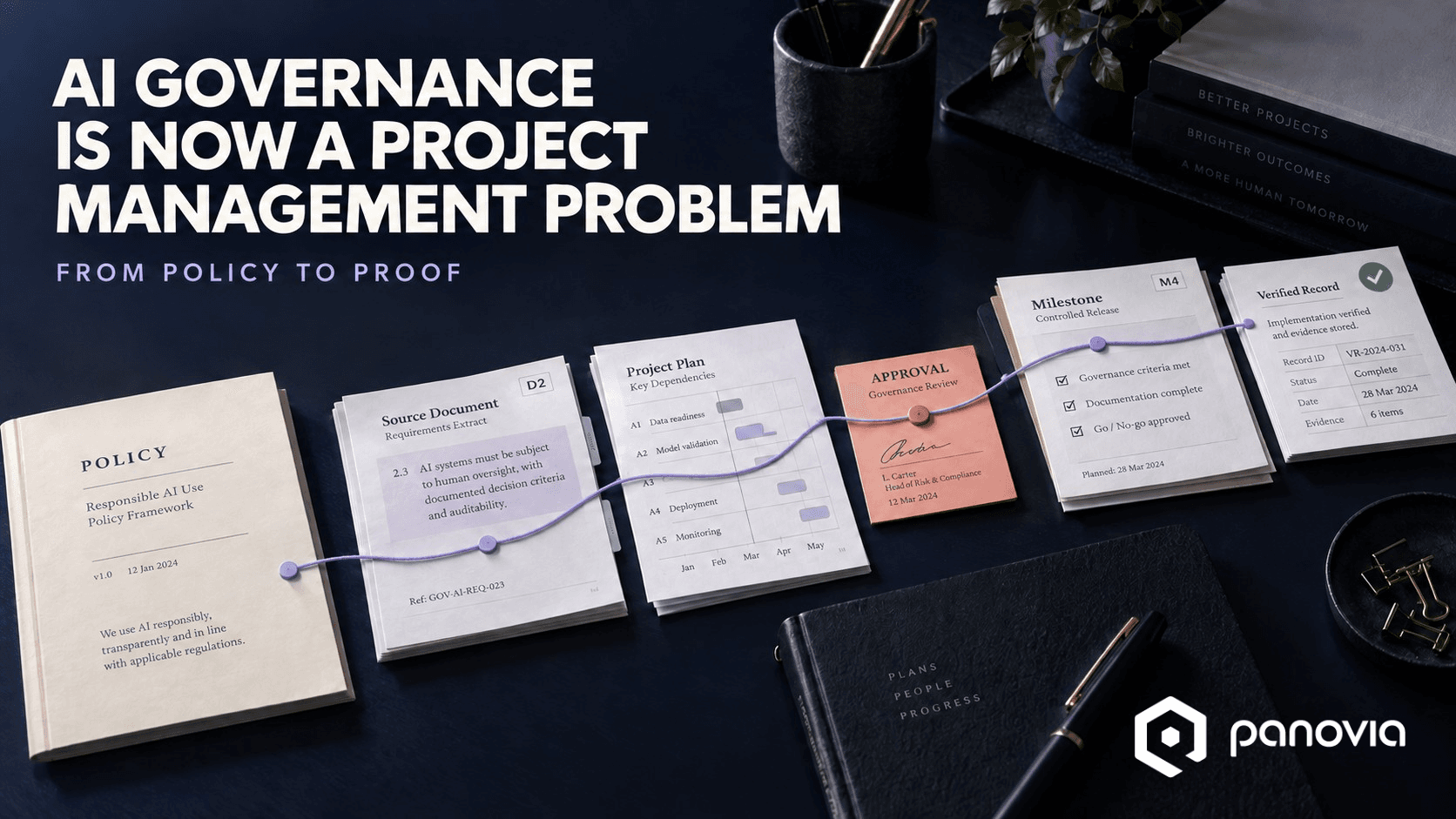
AI governance in project management means attaching policy to the actual work: the evidence used, the person accountable, the action permitted, the dependencies affected, the approval required and the record of what happened.
AI governance has acquired a calendar. This is inconvenient for anyone whose governance programme was enjoying a long and peaceful life in PowerPoint.
On 2 August 2026, the European Commission began enforcing parts of the EU AI Act, while new transparency requirements started to apply to certain AI systems. In June, the Project Management Institute published what it describes as the first global standard for applying AI in project work. The debate is moving from What principles should we adopt? to Can we show that the principles altered what people and systems did?
In brief: AI governance becomes operational when each consequential AI-assisted decision preserves its trigger, evidence, authority, impact, action and verification. Without those connections, a policy cannot prove that its rules reached the work.
The policy is finished. The difficult bit starts now.
The European Commission's announcement was specific rather than universal. The exact obligations depend on the system, its role and its use; not every organisation, product or project is subject to every requirement.
It is no longer enough to say an AI system should be transparent, supervised or used within limits. Those statements must become controls in live work.
Two developments anchor 2026 for delivery leaders:
| Date | Development | Why delivery leaders should care |
|---|---|---|
| 9 June 2026 | PMI published its global standard for AI in project work, built around technology-neutral guidance and human-in-the-loop oversight. | AI governance now has a professional delivery framework, not only technical and legal ones. |
| 2 August 2026 | The European Commission began enforcing parts of the EU AI Act, and specified transparency requirements started to apply. | Organisations must translate applicable duties into actual disclosures, checks, approvals and records. |
An attractive flowchart is not compliance.
A risk register is not a force field.
AI governance in project management is delivered through projects
PMI president Pierre Le Manh put the matter neatly:
“AI transformation succeeds or fails in the projects and programs that deliver it.”
Projects convert intentions into changed systems, services and behaviour. Governance becomes executable there — or evaporates.
The translation looks something like this:
| Governance intention | Project control |
|---|---|
| Require human approval | Define the decision right, approval threshold and gate in the workflow |
| Meet a transparency duty | Produce the required disclosure, attach it to the deliverable and verify publication |
| Limit an agent's authority | Restrict its actions, data, duration and escalation conditions |
| Manage an exception | Record the rationale, accountable owner, compensating controls and expiry date |
Policies deal in categories; projects deal in events. A supplier moves a date. A model recommends a change. Governance must make the rule visible at that moment and carry its consequence into the work.
That is why AI governance is now a project management problem — not exclusively, but unavoidably. Legal, security, data and risk teams remain essential. The proof is created in the work itself.
Where governance disappears
Most governance failures look like ordinary administrative gaps.
The evidence break. The recommendation survives, but its source, version or date does not. The result may be right. It is still difficult to govern because confidence cannot be separated from provenance.
The authority break. The action is recorded, but responsibility is blurred. A log may identify a service account or application without showing who permitted the action, under which mandate or with whose accountability.
Authentication tells you what credential acted. Authority tells you why it was allowed to.
The propagation break. A decision is approved in one place while the rest of the project carries on. A changed requirement misses the schedule; a moved milestone misses the supplier. The approval exists. The project it was meant to govern does not know about it.
The memory break. The final state is retained, but the route to it disappears. Later, the team can see what the plan says but not what changed, which alternatives were rejected or why the accepted path was reasonable at the time.
An audit trail that cannot show why the plan changed is a very orderly collection of loose ends.
Human in the loop is a design, not a slogan
PMI's standard places human-in-the-loop oversight at the centre of AI-enabled project work. The phrase is now common enough to sound reassuring without saying much.
A human somewhere near the loop is not the same as a controlled decision. Useful oversight requires five things:
- Named decision rights. The team knows which person or role may approve each type of change.
- Explicit thresholds. Routine work may proceed within limits; material changes to scope, cost, timing, ownership or compliance require review.
- Decision-ready context. The approver sees the evidence, uncertainty, alternatives and affected dependencies — not merely an Agree button.
- A stop condition. The AI pauses when novelty, ambiguity or consequence exceeds its authority.
- A durable effect. The approval and its consequences are recorded and verifiable.
Not every AI action needs synchronous approval. Requiring a person to bless every summary or reminder would encourage rubber-stamping. Human judgement belongs where consequence begins: before an AI-assisted action materially changes commitments, rights or the project's current state. That is authority designed into the work, not supervision as theatre.
The minimum viable decision thread
A useful AI project audit trail should answer more than what happened? It should connect the event to its reason, authority, consequence and proof.
| Element | What must remain legible |
|---|---|
| Trigger | What changed or prompted the decision? |
| Evidence | Which source, version and date support it? |
| Decision | What was chosen, rejected or deferred? |
| Authority | Who was permitted — and accountable — to decide? |
| Impact | Which milestones, dependencies, requirements and parties move? |
| Action | Who must do what, and by when? |
| Verification | What proves that the change reached the work? |
If a supplier moves a delivery date, the email is the trigger; the current schedule and contract are the evidence; the programme director's response is the decision. Their role establishes authority. The installation window, testing plan and client commitment form the impact. Named owners receive revised actions; updated milestones and completion checks provide verification.
Together, the seven elements let a reviewer reconstruct what changed and whether the organisation responded as intended. That is project decision traceability.
Why faster AI output can make governance harder
Many AI programmes assume that if people produce more, the organisation will move faster. Sometimes the new output simply reaches the next constraint sooner.
DORA's 2026 research on generative AI in software development offers a bounded example. A 25 per cent increase in AI adoption was associated with a 1.5 per cent decrease in delivery throughput and a 7.2 per cent decrease in stability. DORA points to larger batches and review pressure as plausible system effects.
The evidence concerns software development, and the relationships are associative, not causal. It is not a universal law. The system lesson is useful: generating work is not the same as moving controlled work.
If AI doubles the proposed changes while approvals, evidence checks and dependency updates remain disconnected, governance does not become twice as good. The queue becomes twice as interesting. Value lies in a consequential change moving through evidence, authority, impact and verification without losing its meaning.
Governance should sit above the tools, not demand another migration
Programmes rarely lack systems. They lack one place that carries the whole story.
The plan may live in one platform, the source document in another, the approval in a meeting and the action in a task manager. Asking everyone to abandon those systems is an excellent way to begin a three-year migration.
Panovia sits above existing systems of record and turns documents, messages, revisions and decisions into a source-backed project record. Material statements retain their source, location, version, date and confidence; weak evidence is visible.
Panovia builds work packages, milestones, owners, schedules and dependencies from available information, then stays with the project as it changes. It shows what may be affected and the paths forward. The AI proposes; a named person approves consequential actions. Nothing is silently deleted.
This does not replace sound policy, expert judgement or well-designed controls. It gives them somewhere to operate: the rule stays connected to its source, the approval to its owner, the change to its dependencies and the completed action to its proof.
The same principle explains why more AI agents can make a project plan worse. More capable actors do not repair a fragmented project state. They need a shared, governed version of reality.
From proof of policy to proof of practice
The first phase of AI governance was declarative: principles, committees, inventories and prohibitions. That work matters.
The next phase asks whether a requirement became a control, reached the right decision, changed the affected work and was verified.
The next phase of AI governance will not be won by the organisation with the thickest policy.
It will be won by the one that can show how a rule reached a decision, how the decision changed the work and who checked that it landed.
It is a coordination problem, a memory problem and — now — a project management problem.
See Panovia on a live project
Bring the documents and the intended outcome. Panovia will build the plan and show its working.
See how Panovia keeps evidence, approval and impact connected as governance rules reach the work.Frequently asked questions
What is AI governance in project management?
It turns AI policies and obligations into controls within live project work. Each material AI-assisted decision stays connected to its evidence, accountable owner, affected dependencies, approval and verification.
How do you operationalise AI governance?
Convert each applicable requirement into a named project control. Define its owner, trigger, evidence, approval threshold, exception path and proof of implementation. Keep those elements connected as the project changes.
What does human in the loop mean in a project?
A named, authorised person retains decision rights at defined points, receives enough context to judge the proposal and leaves a record of the approval and its effects. Routine actions need not all require manual permission.
What should an AI project audit trail contain?
It should contain the trigger, source and version of evidence, decision, accountable authority, impact on milestones and dependencies, assigned action and verification. Technical logs do not replace organisational rationale.
How can AI decisions be traced across a programme?
Use one decision thread across documents, plans, messages and systems of record. Give material claims persistent citations, assign owners and approval gates, link decisions to affected work and retain each consequence's status.
Sources
- European Commission, Commission starts enforcing AI Act rules and new transparency requirements on 2 August, 31 July 2026.
- PMI, PMI Publishes World's First Global Standard for AI in Project Work, 9 June 2026.
- DORA, Impact of Generative AI in Software Development, 2026.
- Panovia, The Coordination Tax: When More AI Agents Make the Plan Worse.
- This article provides general information, not legal advice. Organisations should assess the EU AI Act and other obligations in the context of their specific systems, roles and jurisdictions.