The next generation of project software will not be judged by how many agents it can summon. It will be judged by whether those agents can share the same reality.
If one clever agent is useful, five must be a department.
The arithmetic is seductive. Add specialists, appoint a coordinator, assume capability rises with headcount. The software industry has recreated the org chart and, remarkably, included the meetings.
A project does not oblige. It is a chain of dependencies wearing a Gantt chart as formal clothing. The moment one agent's output changes another agent's inputs, intelligence becomes a coordination problem.
In brief: the coordination tax is the additional time, cost and risk created when several AI agents divide work, exchange context, reconcile outputs and recover from one another's errors. Multiple agents tend to help when work is genuinely parallel. They can make project plans worse when work is sequential, interdependent or tied to a changing shared state.
That is the distinction now emerging from the evidence—and it matters rather more than the number of animated circles in an agentic-AI demonstration.
What does the latest research say about AI agent coordination?
A study by Yubin Kim and colleagues, published in Nature Machine Intelligence on 24 July 2026, tested 260 configurations across six agentic benchmarks, five system architectures and three model families. The researchers broadly standardised tools, prompts and compute so they could isolate the effect of coordination structure.
The spread was dramatic.
On a decomposable financial-reasoning benchmark, the strongest multi-agent architecture beat the single-agent baseline by 80.8%. On PlanCraft, a sequential planning benchmark in which each action changes the state on which the next action depends, every multi-agent architecture tested performed worse. The decline ranged from 39.1% to 70%.
The decisive variable was not simply difficulty. It was whether the work could be separated without one branch repeatedly changing the state another branch relied upon.
The study's predictive model selected the best-performing architecture in 87% of held-out configurations. That does not make the percentages a forecast for every live programme. Benchmarks simplify; real projects add suppliers, politics, incomplete information and contractual consequences. But the underlying warning travels well: architecture must follow the structure of the work.
More agents is not a strategy. It is a headcount.
Why is parallel work different from project work?
Five agents can research five markets at once. One agent's search does not normally invalidate another's. That is parallel work, and breadth genuinely helps.
Now take a delivery programme. A supplier moves a milestone. That changes the installation sequence, the testing window, the resource plan and possibly the completion date already promised to a client.
Those work packages cannot be revised as though they were separate research prompts. Every participant needs to know what changed, what it affected and which version of the plan now counts.
This is the difference between a bag of tasks and a project. A bag of tasks divides. A project contains sequence, ownership, constraints, approvals and consequences.
The hard problem in AI project planning is not producing more output. It is keeping every participant—human and artificial—oriented to the same current reality.
An agent can therefore produce a perfectly sensible answer to a project that no longer exists. No hallucination is required. Yesterday's truth will do.
Where does the multi-agent coordination tax appear?
Coordination overhead in a multi-agent system is the work required to keep separate agents aligned. It covers passing information, preserving context, reconciling conflicting outputs, checking shared assumptions and recovering from errors.
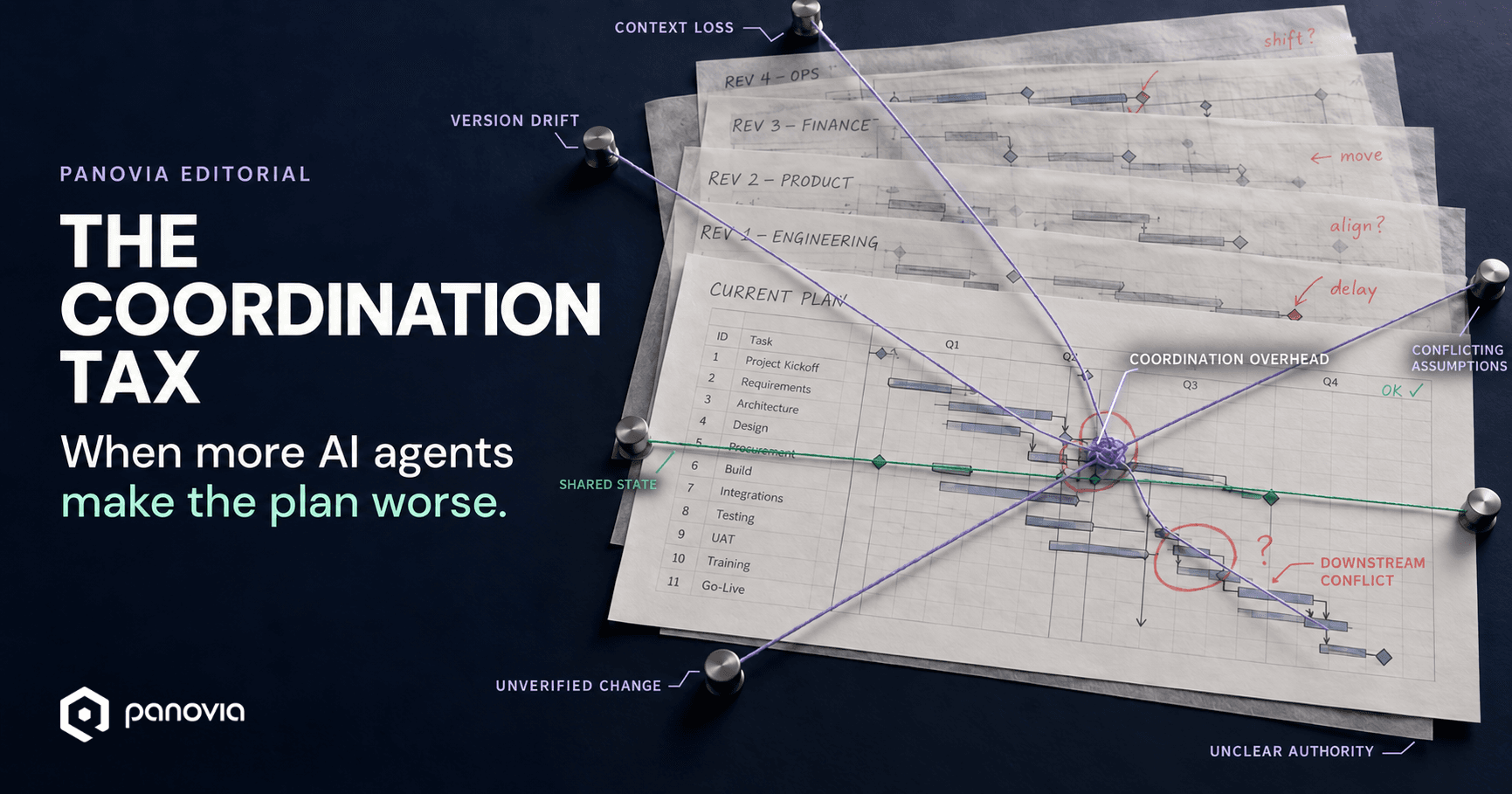
In project work, the tax has several familiar disguises:
- context fragments at a hand-off and a constraint disappears with it;
- two agents act on different versions of the plan;
- a locally sensible decision creates a downstream conflict;
- separate agents duplicate the same work while leaving another task untouched;
- an error travels through dependent steps before anyone notices; and
- nobody can tell whether an output is proposed, approved, blocked or complete.
This is not a single-paper curiosity. A peer-reviewed NeurIPS study led by researchers at UC Berkeley analysed more than 1,600 execution traces across seven multi-agent frameworks. It identified 14 failure modes involving system design, inter-agent misalignment and task verification. These included step repetition, information withholding, ignored input, lost conversation history and incomplete verification.
Anthropic's research on emerging multi-agent systems, published on 13 August 2026, points in the same direction. Swarms were genuinely useful when agents searched largely independent areas for software vulnerabilities. When between ten and eighty agents shared a codebase to build a game, the work developed richer and changing interdependencies. Agents frequently created conflicting work that was never merged.
The researchers tried letting agents organise themselves, prescribing roles and appointing one agent as CEO. None of the three instructions materially improved the resulting games.
A title, it turns out, is not an architecture.
“Coordination doesn't naturally emerge from stronger intelligence nor alignment at the individual level.”
When do multiple AI agents actually help?
Multiple agents are useful when the work genuinely separates and the result is valuable enough to justify the additional cost.
Anthropic has reported that its multi-agent research system outperformed a single-agent version by 90.2% on an internal breadth-first research evaluation. Separate agents could explore independent lines of enquiry and return compressed findings to a lead agent.
There was a bill. Anthropic said multi-agent systems used about fifteen times as many tokens as ordinary chat interactions. Its conclusion was sensibly conditional: the design works best for valuable tasks with substantial parallelism, large amounts of information and several complex tools.
The useful distinction is not one agent versus many. It is coupled work versus separable work.
| Shape of the work | Better starting architecture | Why |
|---|---|---|
| Independent investigations with one common question | Parallel agents with a lead orchestrator | Each branch can explore without repeatedly changing the others' inputs |
| Sequential planning with hard dependencies | One reasoning thread or tightly centralised orchestration | The work benefits from a unified history and ordered constraint handling |
| Work across a changing project state | Agents connected to one governed project record | Every participant needs the same current facts, versions and constraints |
| High-impact changes to scope, dates or ownership | AI proposal followed by named human approval | Task completion should not be mistaken for authority |
| A simple task with a clear path | The smallest sufficient system | Extra agents add cost before they add capability |
Sometimes the sophisticated choice is to deploy fewer agents. This is disappointing only if the objective was to win a diagram contest.
What must reliable agentic project management provide?
A coordinated project environment needs more than a collection of capable agents. It needs a structure through which people and agents can see what is true, what is changing and what requires a decision.
At minimum, it needs:
- one explicit outcome and a current definition of done;
- a shared, live project state rather than separate conversational memories;
- visible dependencies and change impacts;
- bounded agent responsibilities and clear hand-off rules;
- named owners and approval points;
- statuses that distinguish proposed, accepted, blocked and completed work;
- verification before high-consequence outputs alter the plan; and
- a recoverable record of what changed, why it changed and who accepted it.
The wider standards conversation is moving in this direction too. The NIST AI Agent Standards Initiative, launched in February 2026 and updated in August, focuses on interoperability, agent identity, authentication and security. Exchanging messages is the easy part. Establishing the conditions under which those messages may safely become action is harder.
This is the territory Panovia is built around: a living project environment that connects outcomes, owners, dependencies, decisions and change impacts as the work moves.
Panovia builds the plan from the information already available, then stays with the project as it changes. It can identify what may be affected and present the available paths forward. Proposals retain their sources. Consequential changes remain subject to named human approval.
The philosophy behind that approach is explored further in our article on the project world model. The short version is simpler: technology should carry the complexity without taking the project away from the people responsible for it.
The thirty-second test for AI agent coordination
There is a quick test for any system claiming to coordinate agents:
If Agent A changes the date, scope or assumption behind Task X, can Agent B see every affected piece of work—and does everyone know who must approve the change?
If the answer is no, the organisation has several agents but not a coordinated project environment. It has more actors and no reliable way to share consequences.
This is the problem with judging agentic systems by the intelligence of their parts. A project can contain several excellent decisions and still be an excellent failure.
A shared reality beats a crowded room
The industry does not need an infinite meeting of synthetic colleagues, however articulate the attendees.
Delivery work needs an environment in which people and agents see the same outcome, the same dependencies and the same consequences—and in which a change made in one corner surfaces everywhere it matters.
Capability is becoming abundant. Shared reality is not.
The next advantage will not come from filling the room. It will come from making coordination legible: shared state, explicit hand-offs, verifiable evidence and clear human authority.
More workers help when the work separates cleanly. Projects rarely oblige.
Because if twelve agents need a thirteenth to explain what the first twelve have done, the project has not escaped the coordination tax.
It has automated it.
Keep the plan connected as work changes
Give people and agents one shared view of outcomes, dependencies, decisions and their consequences.
See how Panovia keeps plans, dependencies and decisions connected as work changes.Frequently asked questions
Do more AI agents improve project delivery?
Not automatically. Multi-agent systems can improve performance when work divides into genuinely independent branches. They can perform worse on sequential project tasks where each step changes what the next step needs. Reliable AI agent coordination depends on matching the architecture to the work and maintaining one shared project state.
What is coordination overhead in a multi-agent system?
Coordination overhead is the time, cost, context and verification required to keep multiple agents aligned. It includes transmitting information, reconciling conflicting outputs, rechecking assumptions, preventing duplicate work and recovering from errors. As dependencies increase, this overhead can outweigh the benefit of adding more agents.
Why do multi-agent systems struggle with sequential tasks?
Sequential tasks require each step to use an accurate result from the step before it. Dividing that chain between agents creates hand-offs, compressed context and more opportunities for errors to propagate. If agents operate from different versions of the project state, a locally correct action can leave the wider plan inconsistent.
Is a central AI orchestrator always the best design?
No. A central orchestrator can reduce unchecked error propagation and help maintain a common plan, but it can also become a bottleneck. The right architecture depends on task structure, tool use, risk and interdependence. Architecture should follow the work rather than a fixed preference for centralisation or decentralisation.
How can project managers govern AI agents?
Project managers need one visible outcome, a shared current state, explicit dependencies, bounded agent responsibilities, named owners and approval gates. Consequential outputs should carry their evidence and remain proposals until an authorised person accepts them. System-level reliability matters more than the apparent accuracy of any individual agent.
Sources
- Kim et al., Capable language models can outgrow the benefits of collaboration, Nature Machine Intelligence, 24 July 2026.
- Kim et al., Towards a Science of Scaling Agent Systems, revised preprint.
- Anthropic Frontier Red Team, Patterns and problems in emerging multiagent systems, 13 August 2026.
- Cemri et al., Why Do Multi-Agent LLM Systems Fail?, NeurIPS 2025 Datasets and Benchmarks Track.
- Anthropic Engineering, How we built our multi-agent research system, 13 June 2025.
- NIST, AI Agent Standards Initiative, created 17 February 2026 and updated 14 August 2026.
- Panovia, The World Model Solution: Moving Beyond Static Digital Paper in Project Operations.