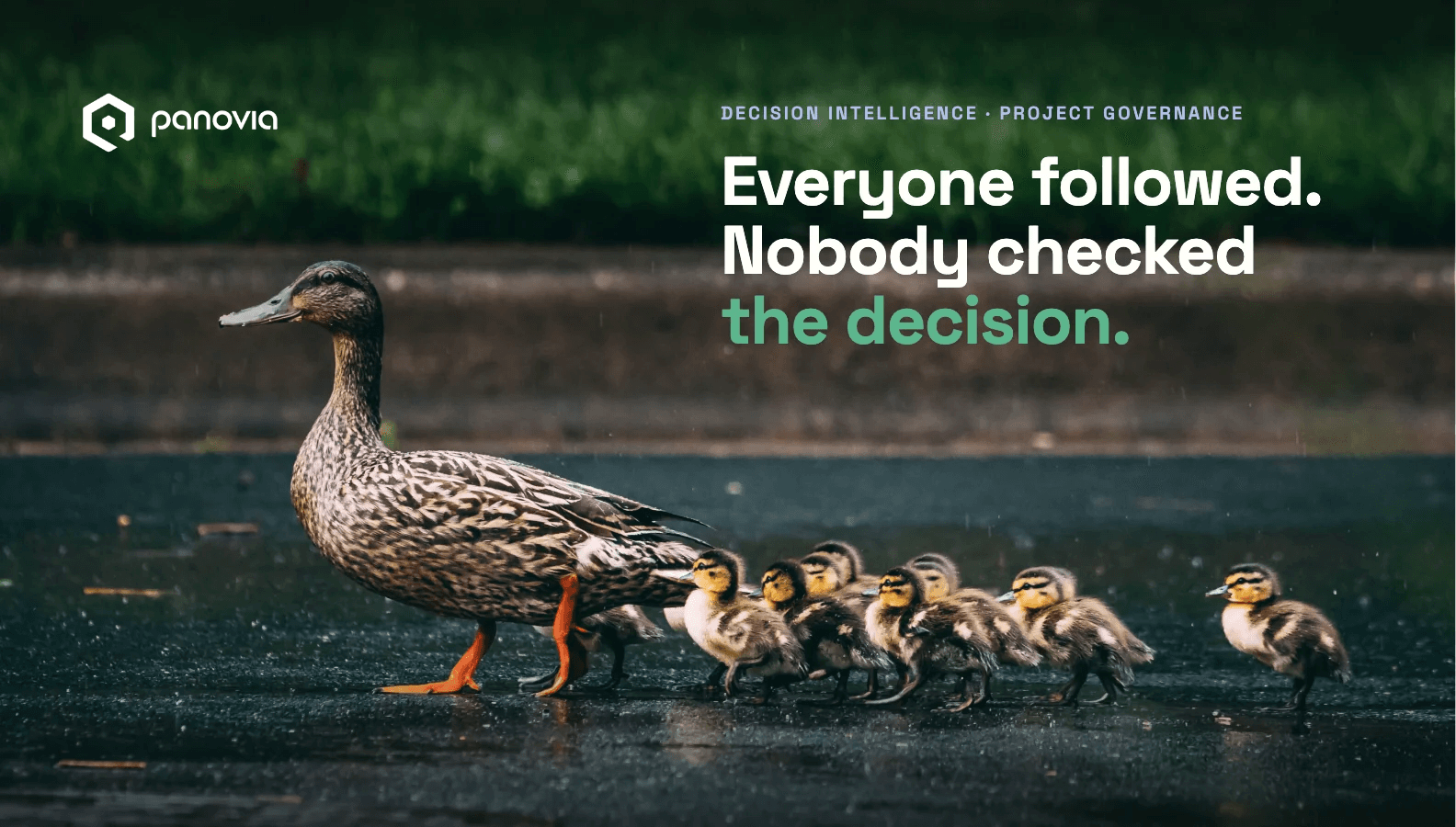
Anyone who has watched a family of ducks cross a towpath knows the scene. The mother goes first and the ducklings follow in a neat, unbroken line, close enough to touch.
They learn to do this within hours of hatching. On the surface, it looks like the simplest kind of learning in nature: see something moving, follow it. Yet in 2016, two zoologists at the University of Oxford discovered that newly hatched ducklings are taking in a great deal more than simple movement.
People in the workplace learn by following too. So, increasingly, do the AI tools we deploy across our projects and so does anyone who inherits a complex asset or a building. What any of them can learn depends on what they can see. At Panovia, we believe most teams pass on their decisions while quietly losing the reasons behind them. Today, the cost of that gap is rising sharply.
How ducklings learn the underlying rule
In a landmark study published in Science, Oxford researchers Antone Martinho and Alex Kacelnik tested how newly hatched mallard ducklings imprint on objects. Rather than showing the birds a single object, they exposed them to a pair of moving shapes. Some ducklings saw two identical objects. Others saw two objects that differed in shape or colour.
Later, the researchers presented the ducklings with entirely new pairs they had never encountered before. The results were striking:
- Same-pair imprinting: Ducklings that first followed two identical objects consistently chose to follow unfamiliar pairs of identical objects.
- Different-pair imprinting: Ducklings that first followed two mismatched objects preferred unfamiliar pairs that were also different from one another.
Nobody rewarded them. Nobody trained them. Until that experiment, relational concept learning of this kind had mostly been observed in primates, crows and parrots after months of intensive reinforcement. The ducklings grasped an abstract rule on their very first day of life because the logic was visible in what they followed.
Why workplace context disappears during handovers
People joining a project team learn in much the same way. They watch an experienced colleague and replicate the workflow. The visible output travels well: the updated drawing, the revised commercial clause, the final sign-off. The reasoning behind those moves rarely makes the journey.
When a senior engineer leaves or a project moves to a new phase, the newcomer sees what was done without knowing why a detail was altered after a site walk or why a specific subcontract clause requires a double check.
In a September SHRM report on workforce brain drain, behavioural scientist Gleb Tsipursky highlighted this exact divide. He noted that AI is most valuable when it “captures why experienced employees made decisions, not just what they did”. Rather than merely archiving static files, organisations must capture human context before institutional memory walks out the door. While Tsipursky is offering practitioner guidance rather than clinical data, the distinction he draws sits at the heart of modern project delivery.
What happens when the big duck is a machine?
As generative AI and machine learning take on more drafting, scheduling and compliance checks, the “big duck” that junior staff follow is increasingly an algorithm. That changes how knowledge is preserved or eroded.
In February 2026, Jin Gerlach of the University of Passau and Don Lange of Arizona State University published a paper in the Academy of Management Review titled Fading Memories: The Role of Machine Learning in Organizational Knowledge Depreciation. They argue that repeated cycles of relying on and patching machine learning systems can accelerate the loss of an organisation's core expertise, simply because humans practise the underlying judgement less often. Unlike older, rule-based software that acted as a stable store of explicit logic, modern statistical models obscure the reasoning behind their outputs.
Although Fading Memories is a conceptual paper proposing a framework rather than measuring a live cohort, Gerlach issued a sharp warning in the university's research announcement: employees who uncritically absorb the outputs of an outdated or drifting model risk actively corrupting what the team knows.
Ducklings succeed because the rule is built into the signal.
In modern project environments, the reasoning is buried in an unminuted Teams call, a 90-message email chain or one consultant's memory. A newcomer copies the precedent and guesses at the rationale. An AI assistant ingesting those same fragmented records is trapped in the exact same blind spot.
Gateway 3 and the golden thread: a live test for UK construction
In England, passing on the reasoning behind decisions is no longer just good governance. Under the Building Safety Act, anyone delivering a higher-risk building (at least 18 metres or seven storeys with two or more residential units, or a hospital or care home) must maintain a digital record known as the golden thread.
Guidance from the Building Safety Regulator requires clients and principal designers to maintain a single source of truth with strict version control, alongside a formal change control plan and log. At completion, this digital record transfers to the Accountable Person who will manage the occupied building. That dutyholder must confirm they have received the information in a usable, intelligible format.
The industry is now approaching its first real test of that handover. According to BSR application data reported by the International Fire & Safety Journal, the regulator approved 40 of 42 new-build and conversion applications at Gateway 2 (the stop/go point before construction begins) over a 12-week window, representing a 95% approval rate. Crucially, the same report confirms that no new-build project approved through Gateway 2 has yet reached Gateway 3, the final completion gate.
At Panovia, we view Gateway 3 as a building's imprinting moment. The Accountable Person will inherit thousands of design and construction decisions made by teams they may never meet:
- Why was a specific fire-stopping product substituted mid-build?
- On what technical evidence was a façade detail altered after Gateway 2 approval?
- Who signed off on the change and which downstream packages were checked as a result?
Regulatory guidance sets out what documents must be stored. Yet when an incident occurs or maintenance is planned five years into occupation, the piece a successor reaches for first is the rationale: who agreed each change and on what verifiable evidence.
How Panovia keeps the reasoning in view
| Traditional Project Records | Decision-Led Delivery with Panovia |
|---|---|
| Final drawings and PDFs stored without context | Decisions linked directly to source evidence and rationale |
| Reasoning scattered across emails, chats and calls | Context captured automatically across existing project tools |
| Newcomers and AI tools guess at past precedents | Clear audit trail showing who made the call and why |
| Painful, retrospective handover assembly at completion | Living, structured record ready for Gateway 3 and beyond |
We are building Panovia to ensure that context never separates from the decision itself. Panovia connects to the documents, specifications and communication tools a project team already uses, maintaining a structured, verifiable record of who decided what and on what evidence.
When a colleague, a successor or an AI assistant looks back at a decision, the reasoning sits right beside it, attributed to the person who made the call. AI handles the heavy lifting of gathering, linking and checking that record, while purpose, creative judgement and final sign-off remain firmly with people.
One small habit to start today
The next time an experienced colleague makes a call that others will follow, ask them for one sentence explaining why. Attach that sentence directly to the decision record, specification or drawing log. A fast-moving chat thread is no place to store institutional memory you will need a year from now.
If you are preparing a complex project for handover, managing change control under the Building Safety Act or simply tired of watching hard-won context vanish between phases, bring a real brief to a Panovia demo. You can register your interest today at panovia.ai.
Frequently asked questions
Can using AI cause organisational knowledge loss?
Yes. In their February 2026 Academy of Management Review paper Fading Memories, researchers Jin Gerlach and Don Lange theorise that over-reliance on machine learning systems can accelerate organisational knowledge depreciation. Because staff practise underlying analytical skills less frequently and statistical models do not store explicit rules, teams risk losing core expertise or adopting outdated model outputs.
What is the golden thread in UK construction?
The golden thread is the mandatory digital record of building information required for higher-risk buildings in England under the Building Safety Act. Maintained from initial design through construction and into occupation, it acts as a single source of truth detailing how a building was designed, built and altered, ensuring the Accountable Person can manage building safety effectively after Gateway 3 completion.
How does Panovia help project teams retain decision context?
Panovia is an AI-led project management platform that captures and links decisions, supporting evidence and human approvals across a team's existing tools. By keeping the rationale attached to every work package and change log, Panovia ensures newcomers, successors and AI tools can follow the true logic of a project rather than guessing at past intent.