The project manager of the future may have fewer updates to write and a more difficult question to answer: is this still the right project?
A report can be produced more quickly. A schedule can be revised. Neither settles whether the investment still makes sense, whether the organisation can absorb the change or whether the people involved are working towards the same outcome.
Those questions have always belonged to good project management. As AI takes on more of the preparation around them, organisations have an opportunity to give them more weight in the job itself.
Our view at Panovia is that the role will become more commercially involved, with greater responsibility for shaping how work gets done. That will require changes to the organisation as well as the individual.
The work is changing before the job description
In research published on 31 March 2026, the Association for Project Management reported that 27% of 1,000 surveyed UK project professionals described AI as fully embedded in their workflows. Reported applications included forecasting, decision support, administration and reporting. These are respondents' accounts of use, rather than independently measured productivity gains.
The implication is a change in the mix of work. If preparing information requires less effort, a project manager can spend more time interpreting what it means for the undertaking. Whether that happens depends on how employers allocate the released capacity.
Giving someone more projects to supervise is one possible response. Giving them greater involvement in the decisions that determine success is another. The technology does not choose between them.
Commercial understanding becomes part of delivery
PMI's May 2026 Pulse of the Profession report found that 81% of project professionals said projects had become more complex in recent years. It also reported that 31% of complex projects did not achieve the full scope of their originally intended benefits. That is a benefits shortfall, not a claim that all those projects were abandoned.
A project can remain busy while its commercial purpose weakens. A service may be delivered on schedule but attract less demand than expected. A new facility may be completed while its intended operating model remains impractical.
For the project manager, commercial fluency means being able to discuss those possibilities early. Which assumption makes the investment worthwhile? What would change the case for proceeding? Who will own the benefit once the delivery team moves on?
Our expectation is that employers will increasingly value project managers who can connect delivery choices to these questions. To make that expectation reasonable, they must give them access to the business case and a working relationship with the people responsible for it.
Modelling becomes more useful when someone can challenge it
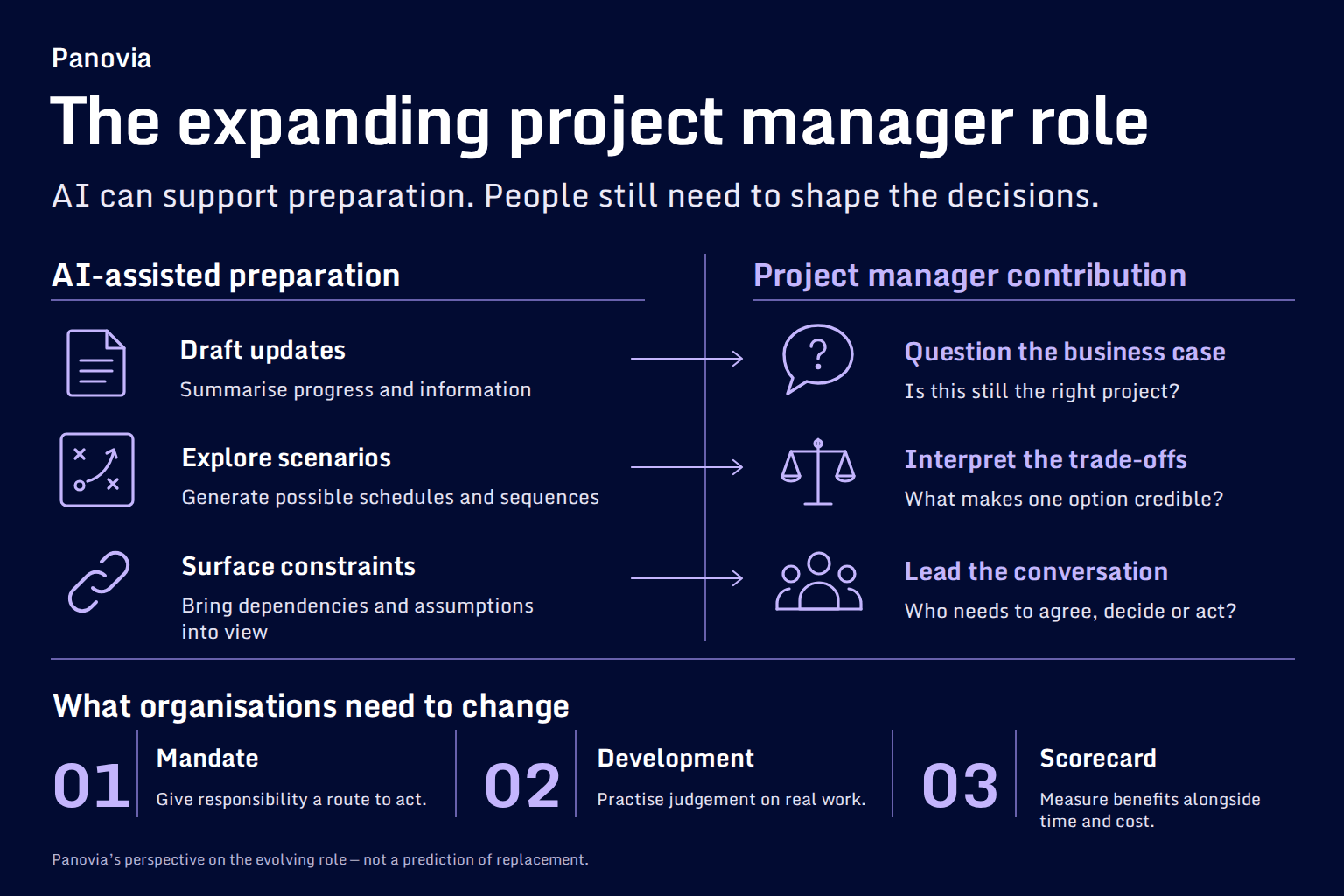
AI can make it easier to produce alternative schedules, summarise constraints and explore possible courses of action. The project manager needs to understand what makes one option credible.
Consider an illustrative financial-services team introducing a new client service. One sequence may reach the first release sooner; another may allow more staff preparation and a narrower initial scope. The decision involves customer expectations, operating capacity and commercial priorities as well as the delivery date.
The useful skill is specifying those differences clearly enough to examine them. Which assumptions are fixed? Which are estimates? What observation would justify changing direction?
We expect scenario design and interpretation to become more prominent parts of project leadership. Training should therefore include working with imperfect data and explaining trade-offs to a sponsor, alongside learning the software.
The role becomes more demanding between people
More analysis does not remove competing interests. Finance may want a smaller commitment. Operations may want a longer preparation period. A customer-facing team may already have made a promise.
In the same APM survey, ethical decision-making and professional judgement, data literacy and AI-enabled decision-making, and leadership in remote or hybrid environments each attracted 33% of responses when respondents identified skills becoming most critical for the future. Stakeholder engagement followed at 32%.
That is a picture of a broader professional role, rather than a purely technical one.
A project manager will need to bring disagreement into a form the organisation can resolve. That includes knowing when a disagreement concerns facts, when it concerns priorities and when someone needs authority to make a choice. An additional dashboard can inform that conversation. Someone still has to conduct it.
Demand may grow while entry routes need rebuilding
PMI's May 2025 talent-gap outlook projected a possible global shortfall of up to 29.8 million project professionals by 2035. It covers a broad family of project-related roles; it is a forecast, not a count of current vacancies or a guarantee of any individual's employment.
The outlook is a reason to examine how the profession develops people. If routine reporting and coordination become more automated, employers should deliberately preserve opportunities for junior colleagues to learn how projects work.
That could include preparing a recommendation, hearing the sponsor's response and following the operational consequences. Experience needs contact with the decisions the professional will eventually be expected to make.
What needs to change now
For 2027, our expectation is an uneven transition. Some organisations will automate parts of the existing job. Others will redesign the role around greater involvement in commercial choices and organisational change. These are Panovia's expectations, not quantified forecasts from the research.
Three practical changes would support the latter approach.
First, rewrite the mandate. Specify the outcomes the project manager helps protect and the decisions they can influence. Greater responsibility needs a corresponding route to act.
Second, change development. Give people opportunities to practise commercial reasoning, scenario assessment and difficult stakeholder conversations on real work, with experienced support.
Third, change the scorecard. Alongside delivery dates and budgets, examine whether intended benefits are being realised and whether the operation can sustain what has been delivered. Set those measures with the sponsor before the project becomes a reporting exercise.
The environment should support the expanding role
This is the direction informing Panovia. It is designed to help teams turn an objective and its supporting material into a connected project, with work packages, responsibilities and milestones they can develop as circumstances change.
As the work develops, teams can examine what a change may affect and consider the next steps. The aim is to give the person leading the project a clearer view of the undertaking and more useful support for the choices ahead.
If you are considering how your project teams should work next, register your interest in a Panovia demo. Bring one undertaking and explore how its planning, coordination and changing requirements could come together.
Questions readers may ask
Will AI replace project managers?
These studies do not establish a replacement rate. They describe adoption, changing demands and a forecast for project talent.
Which skills matter?
Our priorities are commercial understanding, data and AI literacy, scenario interpretation and stakeholder leadership. Develop them through practical work with experienced support.