“Can we fit another row of desks?” the client asks during an office refurbishment meeting.
The designer agrees to test a layout. The project lead agrees to check the cost. Later, a task appears: update the floor plan by Thursday. The fit-out team takes that to mean the new desk positions are agreed and starts preparing the work around them.
This is an illustrative example. Nobody has necessarily recorded the meeting badly. The trouble is that a task to explore an option has acquired the force of a commitment to deliver it.
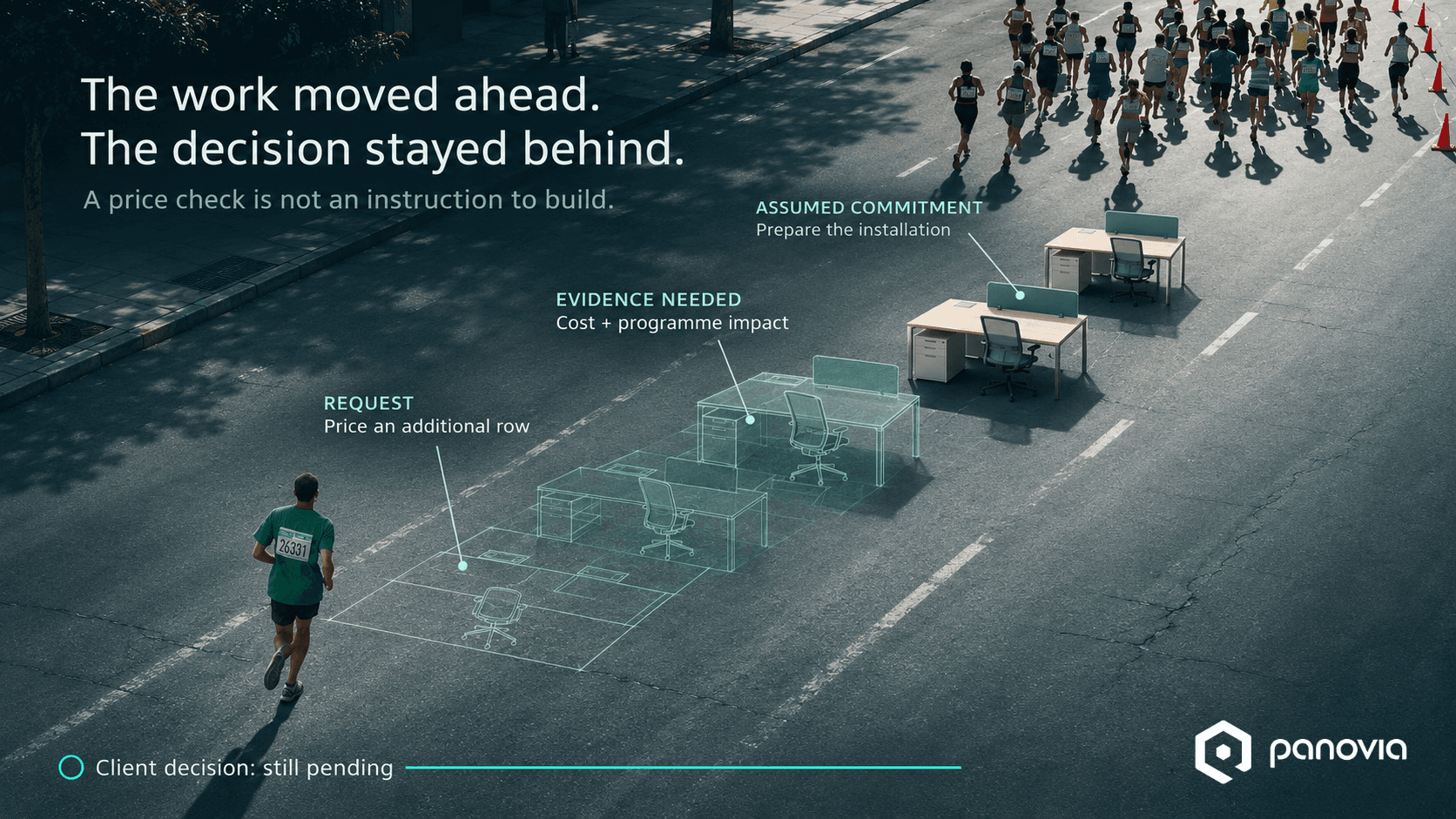
Our view at Panovia is that an action should retain the decision it serves. A colleague picking it up needs to know whether the team is investigating a possibility, developing a recommendation or implementing an accepted change. That status should be supported by the actual agreement and its conditions.
Capturing the action is becoming easier
On 5 November, Asana announced AI Meetings and Tables. Its meeting feature suggests tasks and assignees for attendees to review. Tables connect business records to the work using them. The announcement also describes access to earlier reasoning through Asana Dash.
Read Asana's original announcement.
Those are product descriptions, rather than independent evidence of project outcomes. They make a useful question more pressing: when a discussion becomes assigned work, what exactly has the team committed to?
Follow the commitment through the handover
In the refurbishment example, the client has asked for a feasibility check. The designer's immediate task is to produce an option that can be assessed. The cost check should establish what accepting it would require.
The fit-out team needs to see that state before relying on the new positions. It may need to understand whether to protect a work slot, wait for the comparison or continue with the existing arrangement.
The distinction has practical consequences. Preparing a quotation and preparing an installation can both begin with the same drawing. A clear title on the task will help, but the surrounding evidence has to support the same meaning.
Keep the proposed layout attached to the question it answers. Identify the current agreed arrangement separately, so that people can examine the option without losing the basis for ongoing work.
Give each action a usable boundary
The next action could be written as: “Prepare a layout option and a cost comparison for the additional desks. Keep the current arrangement as the working basis until the client has considered the consequences.”
That is illustrative wording to adapt to the project's established process. It gives the designer a deliverable while telling the next team what it can reasonably assume.
The project lead can then ask the relevant specialists what changes with the layout. Would power or data positions need further work? Would accepting the option affect an existing work slot? Which answer is confirmed, and which still depends on an estimate?
These are questions for the people responsible to establish. An attractive drawing cannot answer them on its own.
Make the trade-off visible before closing the choice
Suppose the comparison shows that the additional desks are feasible, but the work would need to be resequenced. The client can then weigh the extra capacity against the disruption and cost.
If the client accepts the change, record the option selected and the consequence accepted. Retain the basis for the cost and programme assessment. A later colleague should be able to tell why that compromise was considered worthwhile.
If the cost is still provisional, keep that qualification visible. Establish who will return with the missing information and which commitment depends on it. A conditional choice should remain recognisable as conditional when it reaches another tool or team.
Keep the next person's question in view
Panovia, a product by Attimo, is a trusted context layer and decision ledger for work across tools. Our interest is in the point where a conversation changes what people understand they are undertaking.
For this example, the useful record explains why the desk layout was explored, what the comparison established and what the client eventually accepted. It also lets a colleague distinguish that decision from the preparation that preceded it.
Take one action from your next coordination meeting and read it as the person who was absent. Would you start pricing the option or preparing to build it? The record should make the intended next step clear.
Questions readers may ask
What should accompany a meeting action about a project change?
Preserve the question being investigated, the current agreed arrangement and the evidence or decision needed before the option becomes a commitment.
Does accepting an assigned task approve the proposed change?
Its meaning depends on what the team actually agreed. Acceptance of preparation work should not silently establish a wider project commitment.