An RFI regarding a crucial load-bearing connection lands on a project manager’s desk during a chaotic Thursday afternoon. An AI assistant quickly generates a response, referencing the structural specs. The PM skims the draft, gives a quick nod of approval and sends it on its way.
Three weeks later, after the concrete has cured, a routine site inspection catches a major issue: the connection was built using a superseded set of drawings. The AI-generated RFI response sounded convincing, but it was anchored to outdated information.
When the inevitable dispute surfaces, locating the original email takes just seconds. But determining who verified the draft, which drawing revision was used, or if anyone even realized AI generated the answer requires weeks of frustrating forensic dig-throughs.
This scenario highlights a growing crisis across capital projects: while AI investment has surged, the crucial operational paper trail is quietly falling apart.
The Policy Deficit: AI Spending Outpaces Accountable Oversight
In capital projects and heavy construction, margin erosion and schedule delays usually stem from a single root cause: fragmented project memory. As generative AI and agentic tools are deployed across cost estimating, design review and contract compliance, they are introducing an unprecedented volume of synthesised data into the project ecosystem.
However, industry adoption has created a dangerous liability gap.
In July 2026, global advisory firm BRG surveyed 109 construction and development executives across North America, Europe, and Asia-Pacific. The findings, published in their report AI in Construction: Measurable Results, Unclear Benchmarks, reveal an industry moving fast with zero braking mechanics:
- Heavy Capital Allocation: 68% of surveyed firms spent at least $250,000 on AI over the past 24 months, with 37% investing $1 million or more.
- Low Operational Integration: Only 15% report that AI is fully integrated across their project operations.
- Severe Policy Deficits: Only 42% of organisations have formal policies addressing human oversight and accountability, while just 34% address accuracy and data reliability.
As reported by Construction Dive, construction trails far behind energy, finance and retail in establishing human oversight protocols - largely due to a historical lack of strict regulatory enforcement compared to banking or utilities.
The executive concern is already acute: 43% of respondents cited liability for errors in AI-generated work and 40% flagged unclear treatment of AI in existing construction contracts.
The Source Record Problem: Why Verification Fails Without Unified Data
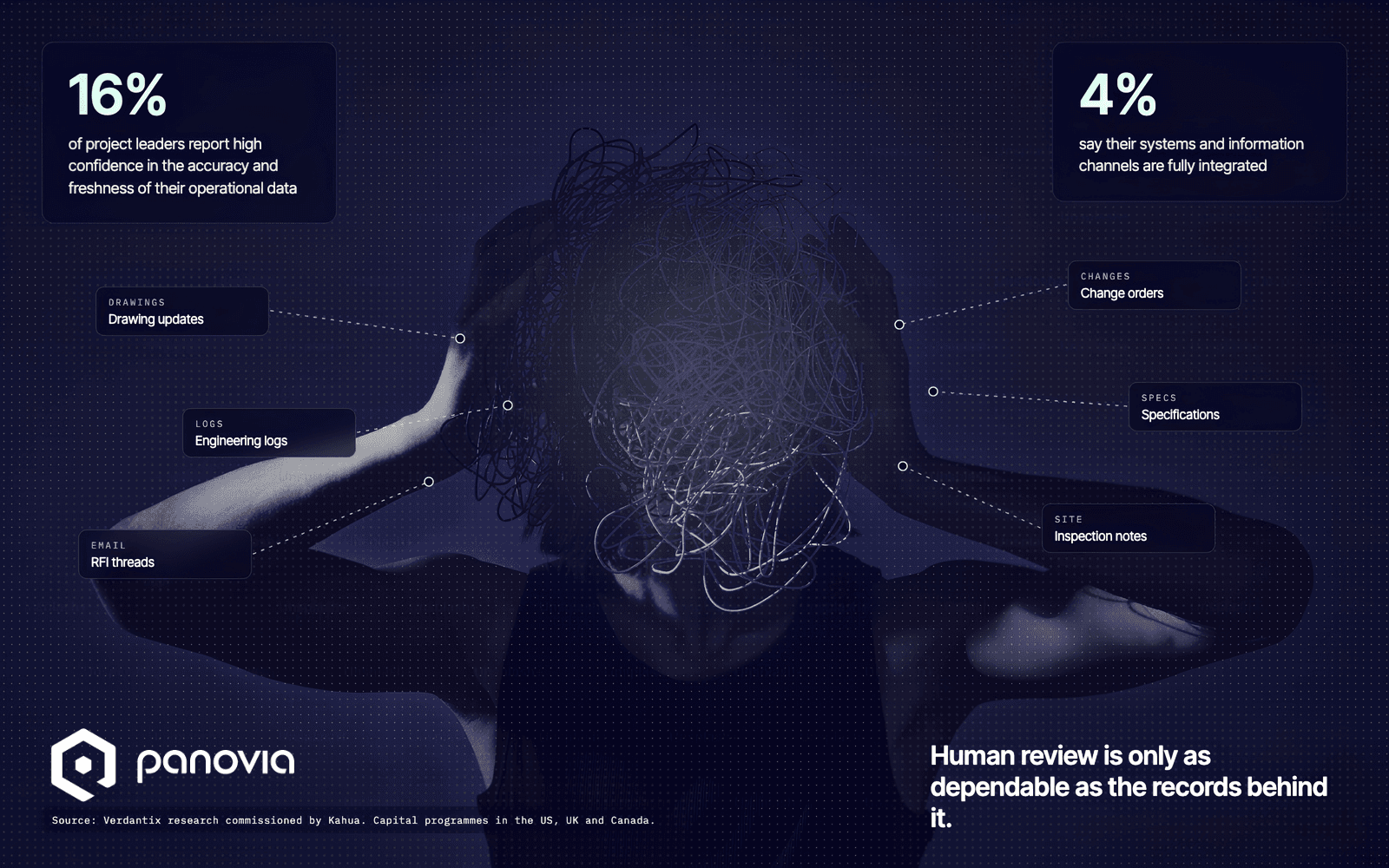
Human review is only as dependable as the records behind it. When engineering logs, drawing updates, and change orders remain scattered across separate systems, checking an AI’s work becomes little more than guesswork.
Independent research by Verdantix, commissioned by Kahua, underscores this systemic challenge across capital programs in the US, UK, and Canada:
- Just 16% of project leaders report high confidence in the accuracy and freshness of their operational data.
- A mere 4% say their systems and information channels are fully integrated.
With 96% of teams navigating disconnected tools, asking a project manager to double-check AI-generated content forces them to dig through disjointed archives. Without a single, immutable project record, human oversight stays superficial.
Building a Decision Ledger for Human-AI Collaboration
Effective oversight can't be enforced through corporate handbooks or lengthy compliance memos. Real accountability must be built directly into a project's day-to-day digital workflow.
At Panovia, we recommend attaching a concise, structured Decision Ledger to every high-stakes, AI-assisted output:
- The Synthesized Output: The exact AI-generated draft or analysis relied upon by the project team.
- The Source Baseline: The specific document, technical specification, or drawing revision used for verification.
- The Review Scope: The precise parameters, calculations, or contractual clauses checked by the human reviewer.
- The Unresolved Risk: Any open ambiguities or unverified assumptions explicitly flagged for field teams.
- The Sign-Off Provenance: Who approved the decision, under what authority, and at what exact timestamp.
This straightforward, repeatable record converts an ephemeral AI response into an auditable project asset - one that holds up during claims, audits, and disputes long after closeout.
Where Panovia Fits: Grounding AI in Immutable Project Memory
Panovia is designed as the trusted context layer and decision ledger for complex operations. Rather than forcing your team to adopt another isolated silo, Panovia stitches together every decision, dependency and document across your existing enterprise ecosystem.
AI should handle the heavy lifting of context collection and draft preparation. Humans must shape, verify and accept the final decision. Panovia provides the continuous memory that proves they did.
Frequently Asked Questions
Who is legally liable when AI-generated work leads to a construction defect?
Liability ultimately rests with the legal entities, licensed engineers, and contractor signatories bound by professional obligations and project contracts. AI tools do not carry legal liability; therefore, documenting human verification and the source baseline used for sign-off is essential for risk mitigation.
What is a Decision Ledger in AI construction workflows?
A Decision Ledger is an auditable record that links an AI-assisted output (such as an RFI response, cost estimate, or submittal review) directly to the human reviewer, the exact drawing or contract revision checked, the remaining uncertainties, and the final sign-off timestamp.
How does Panovia integrate with existing construction management software?
Panovia operates as an overarching context layer and decision ledger, connecting data streams across existing tools (such as Procore, BIM platforms, email, and document repositories) to maintain a continuous, traceable project memory without requiring teams to abandon their current software.
Ready to bring traceable accountability to your AI-assisted project workflows? Register your interest in a Panovia demo and discover how to unify your project evidence and decision sign-offs in one immutable ledger.