The modern project does not fail because nobody made a plan. It fails when a change in one place loses its consequences somewhere else.
A complicated project has many parts. A complex project has parts that change one another.
The distinction sounds academic until a delivery date moves by ten days. Then the schedule changes, a supplier commitment becomes doubtful, a funding milestone shifts, an approval window narrows and a customer promise acquires a rather nervous footnote.
No single change is catastrophic. The difficulty lies in carrying its consequences across the project before people continue working from different versions of reality.
That is the modern coordination problem.
Complexity is now ordinary
In its 2026 Pulse of the Profession, the Project Management Institute found that 97% of project professionals had managed at least one complex project during the previous year. More than half described at least one as significantly complex.
These were not merely large programmes. PMI defines complexity through factors such as ambiguity, interconnected stakeholders, technological change and shifting conditions. In other words, complexity is no longer an exotic property of megaprojects. It is what happens when ordinary work enters a tightly connected organisation.
The cost is substantial. PMI found that roughly one in three complex projects fails, nearly twice the overall project failure rate of 13%. Yet organisations that manage complexity effectively were five times more likely to succeed.
The interesting lesson is not that complex projects need more management. It is that they need a different kind of management.
The task list is no longer the system
Traditional project control is very good at representing work as units: activities, milestones, owners, dates and costs. Each is necessary. None, on its own, explains what happens when the project changes.
Imagine a product launch whose regulatory review is delayed by two weeks.
The task moves on the schedule. But the schedule is only the visible edge of the change. Marketing has already bought a media window. Finance has modelled revenue into the quarter. A supplier has reserved capacity. Customer success has briefed key accounts. The executive committee approved the investment on the basis of a specific time-to-value assumption.
If each team updates its own system correctly but at a different time, the organisation can be locally accurate and collectively wrong.
This is why more status meetings do not reliably solve complexity. A meeting can distribute information. It cannot guarantee that the meaning of the information reaches every dependent decision.
Five relationships a complex project must preserve
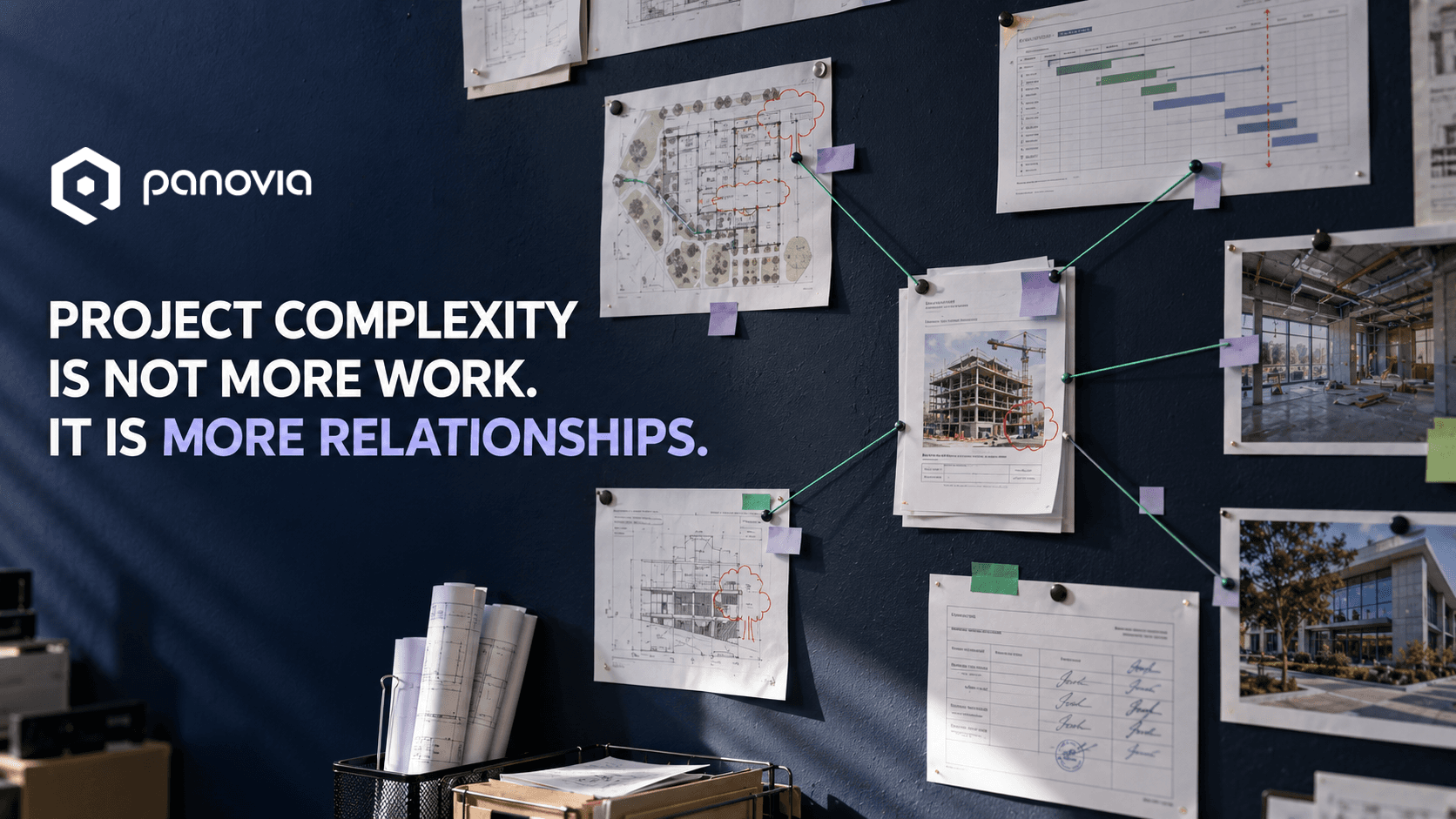
The practical unit of complexity is not the task. It is the relationship. Five relationships deserve particular attention.
1. Outcome to work
Every major activity should connect to the outcome it is meant to advance. When an activity changes, teams can then ask whether the outcome is still achievable rather than merely whether the task remains open.
This prevents a common failure: completing the plan after the original reason for the plan has shifted.
2. Decision to evidence
A decision without its supporting evidence becomes difficult to revisit intelligently. Months later, people can see what was approved but not the assumptions, constraints or trade-offs that made it sensible.
Preserving the link matters because a decision may remain valid even when one input changes. Or it may collapse entirely. Without the reasoning, the organisation must either accept the old call blindly or reconstruct it from institutional folklore.
3. Change to consequence
A changed date, requirement or risk should carry a visible account of what else may move. This is the project's blast radius.
Not every possible effect should become an automatic update. That would replace coordination with chaos. But the relevant effects should be surfaced to the people authorised to judge them.
4. Action to authority
Projects often record who will do something but not who is authorised to decide when conditions conflict. Ownership of an action and accountability for an outcome are not always the same thing.
Complex work needs both to be explicit, particularly when the fastest route forward requires a trade-off.
5. Status to proof
“On track” is useful only when a reader can inspect the evidence behind it. That evidence needs a source, a date and enough context to understand what it does and does not establish.
AI makes this relationship more important. It can assemble summaries and surface patterns rapidly. It can also turn partial information into prose that sounds much more certain than its inputs deserve.
See how Panovia keeps decisions, dependencies and evidence connected as projects change.
Request a working-session demoBetter coordination does not mean more control
PMI's research found that high-performing organisations respond to complexity by prioritising outcomes over activity, alignment over compliance and learning over certainty.
That is not an argument for abandoning governance. It is an argument for making governance responsive to evidence.
A useful operating rhythm asks:
- What changed in the environment or the evidence?
- Which outcomes and assumptions does it touch?
- Which dependencies could transmit the effect?
- Who has authority to decide what changes?
- How will we know the decision reached the live work?
These questions turn project review from a recitation of updates into an examination of the system.
The role of AI is to show the joins
AI is often presented as a way to generate a faster plan, a cleaner report or a better prediction. Those uses can help. But the larger opportunity in complex work is connective.
AI can help identify that a new input may affect a dependency, risk, owner or commitment. It can bring together evidence that lives across documents and systems. It can explain why a proposed consequence has been surfaced.
The human role remains decisive. People determine whether the evidence is sufficient, whether the trade-off is acceptable and what should change in the system of record.
This is the design principle behind Panovia. It is being built as a coordination layer across existing project and delivery tools: connecting outcomes, decisions, plans, dependencies, risks, responsibilities and evidence as information changes. It proposes and explains. People approve what becomes real.
The aim is not to make a complex project simple. That is usually a promise made shortly before reality objects.
The aim is to keep the project coherent: to let a change retain its source, reasoning, consequences and owners as it travels.
Because complexity is not the number of boxes in the plan. It is what can happen between them.
Frequently asked questions
What makes a project complex?
A project becomes complex when its outcomes, stakeholders, technologies, dependencies or external conditions interact in ways that make change difficult to predict and contain. Size can increase complexity, but a smaller project with tightly coupled dependencies can be more complex than a large, repeatable one.
How is project complexity different from project difficulty?
A difficult task may require high skill or effort while still having a stable path to completion. A complex project changes as its parts interact. Managing it therefore requires continuous reassessment, not only better execution of a fixed plan.
Can AI manage a complex project automatically?
AI can help surface relationships, summarise evidence and propose likely consequences. Consequential changes should remain subject to accountable human judgement, with the source and reasoning visible.
How does Panovia support project coordination?
Panovia is being built to connect project outcomes, evidence, decisions, plans, dependencies, risks and responsibilities across the tools teams already use. When information changes, it helps identify possible effects and presents them for human review.