The first version exists. It has a name, an interface and a surprisingly good colour palette. Yesterday, it was a sentence.
For a growing range of creative and software tasks, that transition is easier to attempt. The result may be a demonstration, a mock-up or something already useful. Whatever its maturity, there is a new moment to manage: the idea has become an object people can respond to.
That moment deserves more than a congratulatory screenshot.
It is the beginning of a project. What should this thing become? Who is it for? What needs to exist around it so someone can use it, enjoy it or buy it?
Give the first version a job
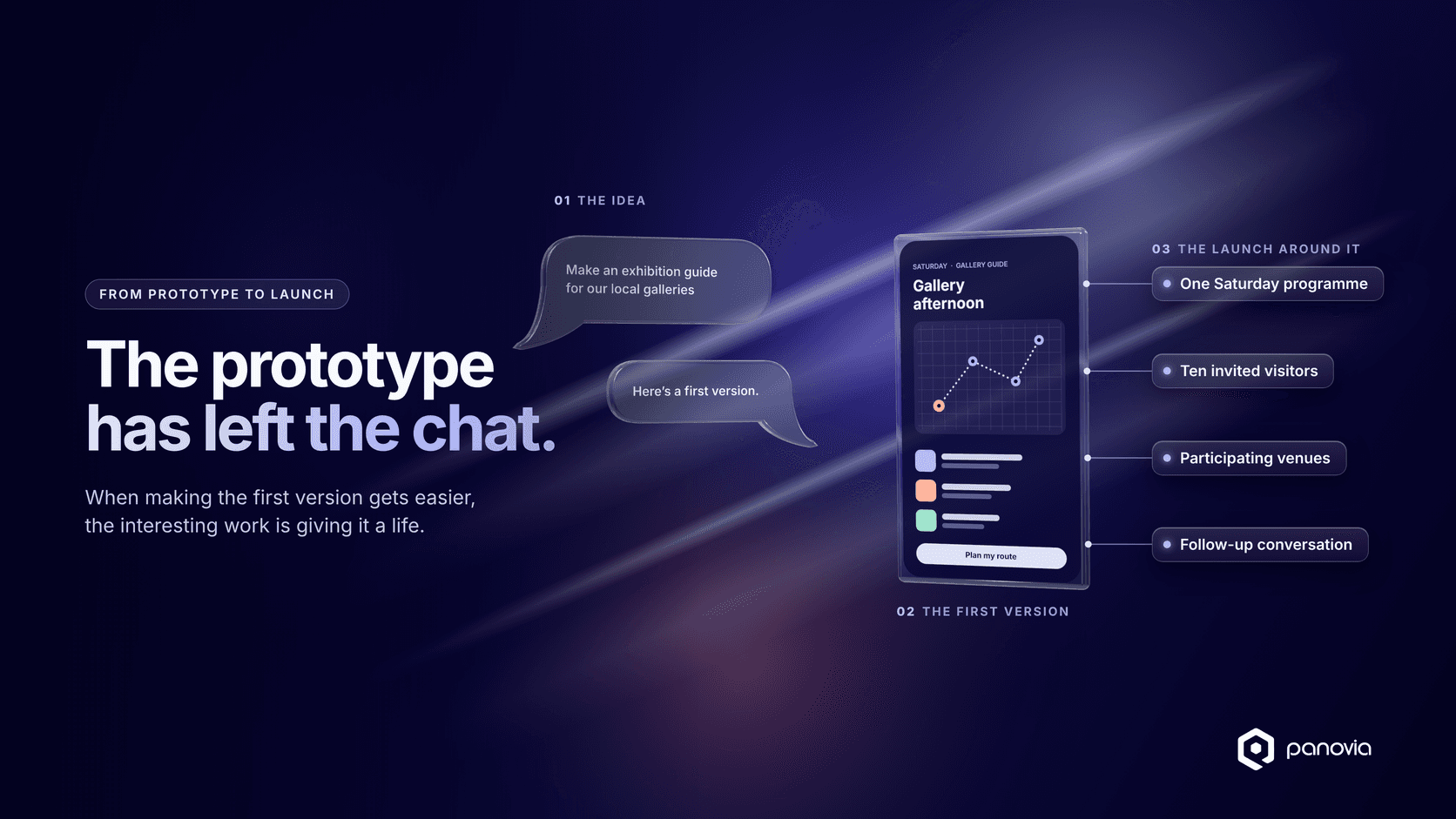
Imagine a designer who has made a prototype for a local exhibition guide. It helps visitors discover small galleries, read about the artists and arrange an afternoon's route.
This is an illustrative example. The prototype is promising because people can now see what the idea means. Its first job should be specific.
Perhaps ten invited visitors will use it for one Saturday programme. That is a different undertaking from building a national platform. It needs a manageable collection of venues, accurate opening information and a way to hear what visitors found useful.
The smaller ambition is an event the team can organise. It gives the prototype an occasion to become real.
Give the launch somewhere to develop
This is a useful place to start with Panovia. Describe the Saturday you want to create and add the brief and venue notes. The prototype becomes one part of a project environment, alongside the work needed to bring people to it.
For this example, organise the proposed project around the invitation, participating venues and visitor experience. Review which work needs to happen together and which choices come first. The idea now has a path you can discuss with the people helping to make it.
Design the surrounding experience
A service is larger than its interface.
The visitor needs to know why this Saturday is worth their time. A gallery needs to understand the offer and how its information will appear. Someone needs to handle a change in opening hours. The person answering questions needs enough knowledge to help.
These are creative decisions too. The invitation's tone, the route between venues and the way artists are introduced all shape the experience.
A prototype can make one part visible while the rest is still taking form. A useful brief names that rest without burying the original idea beneath administration.
For the Saturday launch, the brief might be: organise a gallery afternoon for ten invited visitors, using the prototype as the guide, with confirmed participating venues and a short follow-up conversation afterwards.
Technical polish is now one contribution to the event, alongside venue coordination and the invitation.
Choose what the first launch excludes
An early creation can attract an extraordinary quantity of advice. Add recommendations. Add ticketing. Add a membership scheme. Make it available in six cities.
Each suggestion may be sensible eventually. Together, they can prevent the first useful version from meeting anyone.
Choose the first audience and the first occasion. A directory can begin without a social network. A guided afternoon can begin without a subscription product. A pilot can use a simple invitation rather than an elaborate acquisition system.
This is a creative discipline: protecting the shape of the idea long enough to discover whether it works for someone.
Build around the encounter
Work backwards from the first visitor arriving.
The invitation needs a clear promise. The galleries need to confirm the programme. Information needs to be ready before people plan their afternoon. The route needs to suit the selected audience. The coordinator needs to know which changes to expect and whom to contact.
Several tasks can happen together. Others depend on a preceding choice. The project becomes useful when those relationships reflect the occasion being created.
Keep the launch small enough to observe. Which gallery do people choose first? What information helps them decide? At what point do they put the guide away?
Those answers can influence the second version. They may also reveal that the most useful part is different from the feature the designer liked most.
Let the project expand the ambition
Planning the surrounding work allows the idea to travel further.
The first prototype may belong to one person. The launch brings in a curator, galleries and an audience. They can add knowledge and possibility the interface alone could not supply.
AI-assisted creation can make the invitation to collaborate more tangible. Instead of explaining a hypothetical service, a person can show a first version. The project gives other people a way to contribute.
That is a more interesting future than everyone producing alone indefinitely. More people can begin something and organise the help that makes it better.
Bring your first launch to Panovia
You do not need a finished specification to begin. Bring the rough launch brief and the material that makes the idea tangible. Use the first project conversation to see how the work could take shape around your intended audience.
Ask for a Panovia demo using that brief. Look at the proposed structure, discuss the choices it reveals and follow one part of the launch from preparation to the experience you want to create. That gives you a concrete basis for deciding whether the product fits your work.
The creation has left the chat. Its next audience should be someone with a reason to use it.
Questions readers may be asking
How does a prototype differ from a launch project?
A prototype makes an idea tangible. A launch project organises the audience, setting and supporting work needed to put an appropriate version into use.
How small can a first launch be?
Small enough to give a defined audience a meaningful experience and allow the team to observe it. The appropriate scale depends on the product and its consequences.
Should every prototype become a business?
No. It may become an internal tool, exhibition, experiment or useful one-off. Define its purpose before adding a business model.
How can I begin with Panovia?
Describe the outcome and bring the brief or supporting material you already have. Ask for a project demo to examine how Panovia could help organise the work around it.