A project leader asks a perfectly reasonable question: “What happens if we move this?”
The software should not interpret it as an instruction to move it.
As AI gains the ability to act across business systems, that distinction becomes part of the product. A team needs space to explore a possibility, inspect its consequences and decide whether to proceed. Curiosity should not create a commitment.
This is where project change impact analysis earns its place. It connects a proposed change to the work, constraints and decisions it may affect before those consequences become live obligations.
Capability is only the opening question
Recent discussion of AI agents has moved beyond whether a model can operate software. In its August analysis of computer-use deployments, a16z emphasised the surrounding workflow: validation, escalation, permissions and handling exceptions. Its account is investor analysis informed by operator conversations, not a representative performance study.
A separate ICML 2026 paper, listed by IBM Research, combined 20 case studies with a survey of 306 practitioners. It reported that 68% of the production agents studied executed at most ten steps before human intervention. Reliability remained the leading development challenge.
Those findings do not establish the right number of steps for a project tool. They do suggest a useful question for buyers: where does the system pause, and what can the responsible person understand at that point?
A change worth rehearsing
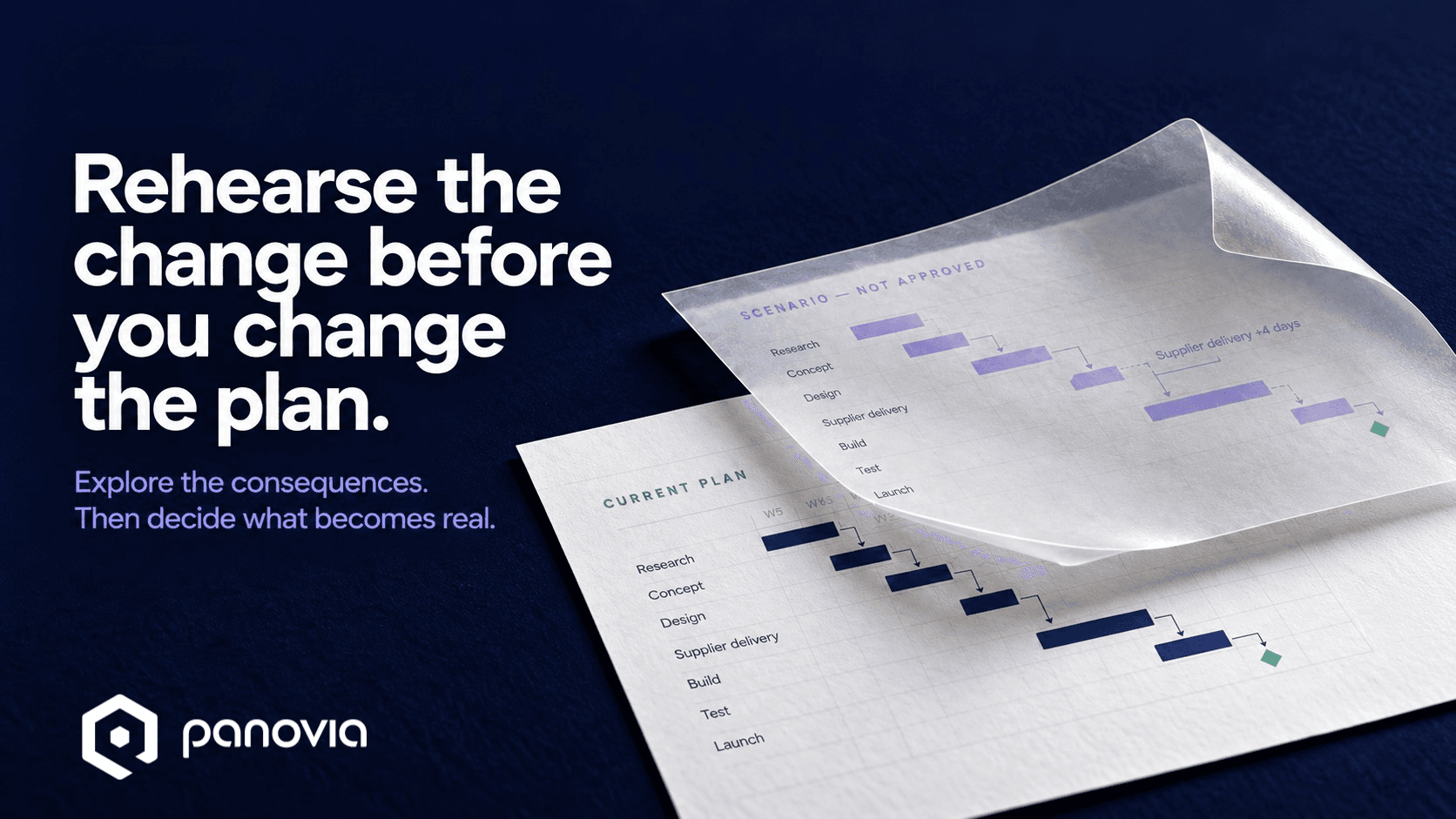
Consider an illustrative customer-service platform migration. The team is preparing to move a group of accounts onto a new system. A supplier now says that a required data extract will arrive four working days later.
Moving the extract's date is easy. Deciding what should happen next is harder.
The receiving team needs time to validate the data. Training depends on a usable test environment. Support coverage has been arranged for a particular weekend. Customer communications describe a date that may no longer be sensible.
The change also creates choices. The team might move the migration, reduce the first cohort or do preparatory work while keeping the validation requirement intact. None is automatically correct. Each protects something and gives something else up.
A useful project environment should help the team examine those choices before any external message is sent or approved baseline revised.
Keep observation separate from inference
The supplier's message establishes a revised delivery expectation. It does not, by itself, establish a four-day delay to the whole programme.
That depends on the actual dependency path, available slack, other work that can proceed and the conditions for acceptance. It may also depend on facts not yet recorded.
This is why source-backed reasoning matters. The user should be able to distinguish the incoming fact from the system's interpretation and from the proposed response. A plausible chain of consequences should remain open to inspection.
An AI-generated list of affected tasks is not necessarily a complete list. Missing dependencies, stale records and informal commitments can all limit the analysis. Showing those limits makes the result more useful, not less ambitious.
What a change preview should contain
Before asking for approval, a project change preview should answer five practical questions.
What changed? Show the source, its version or date, and the specific condition that differs. A new file name is not an explanation.
What may be affected? Show the path through the relevant work packages, commitments and acceptance conditions. Explain why each relationship matters.
What choices remain? Present feasible responses with their assumptions and trade-offs. Preserve “obtain more information” when the evidence is insufficient.
What would become real? State which records would change, which people would be notified and which actions remain outside the proposed approval.
Who is entitled to decide? Identify the authority required. Being able to edit a plan is not necessarily the same as being entitled to alter a customer commitment.
These questions are an evaluation checklist, not a claim that simulation can remove uncertainty. A preview helps people reason under stated conditions. It does not guarantee the future.
Reversibility needs a precise definition
“You can undo it” sounds reassuring until somebody asks what “it” includes.
Restoring a plan does not recall a supplier instruction. Rolling back a database record does not erase an email from a customer's memory. Stopping an agent may not stop work already accepted by another system.
Teams should therefore distinguish between a draft, a reversible internal update and an external commitment that may require corrective action. Recovery might mean restoring an earlier state, issuing a compensating change or escalating to a person. Some consequences cannot be undone.
That distinction belongs before approval. It is not a footnote to discover during the incident review.
Test the interruption as well as the happy path
An AI demonstration can be impressive while revealing very little about what happens when the user changes their mind.
For a contained evaluation, use authorised or synthetic project material. Ask the system to explore the supplier delay. Then correct an assumption: the support team is unavailable on the proposed alternative weekend.
Observe what happens. Does the alternative update coherently? Can the team identify which conclusions no longer hold? Does the original baseline remain intact while options are explored?
Now decline the proposal. Check whether any live records or communications have changed. Finally, ask to see the record of what was considered and what was actually decided.
A product that handles these moments clearly offers a more meaningful demonstration of control than a reassuring label on its homepage.
Where Panovia fits
Panovia is connected project intelligence for work that changes. We are designing it around the reasoning that joins project evidence, dependencies, possible consequences and the person who must decide.
The ambition is to keep the project coherent as reality changes. For a buyer, the next step should be a specific demonstration: one change, the affected path, the available choices and the approval boundary. The supported integrations and actions need to be established for that evaluation, not assumed from a broad promise.
Nothing changes alone. The point of project intelligence is to help people see enough of what follows to make the next decision responsibly.
Before asking a team to commit to an AI-assisted plan, give them a way to examine a different one.
Questions readers may be asking
What is project change impact analysis?
It is the assessment of how a proposed or observed change may affect project work, dependencies, acceptance conditions, costs, risks and commitments. The analysis informs a decision; it is not itself authorisation to change the project.
Is a scenario the same as a forecast?
No. A scenario explores what could follow from stated assumptions. A forecast estimates what is likely to happen using a defined method. Neither should be presented with more certainty than its evidence supports.
Does approving a scenario approve every downstream action?
It should not. The approval should identify the proposed version, scope, authorised actions and exclusions. Additional consequences may require a separate decision.